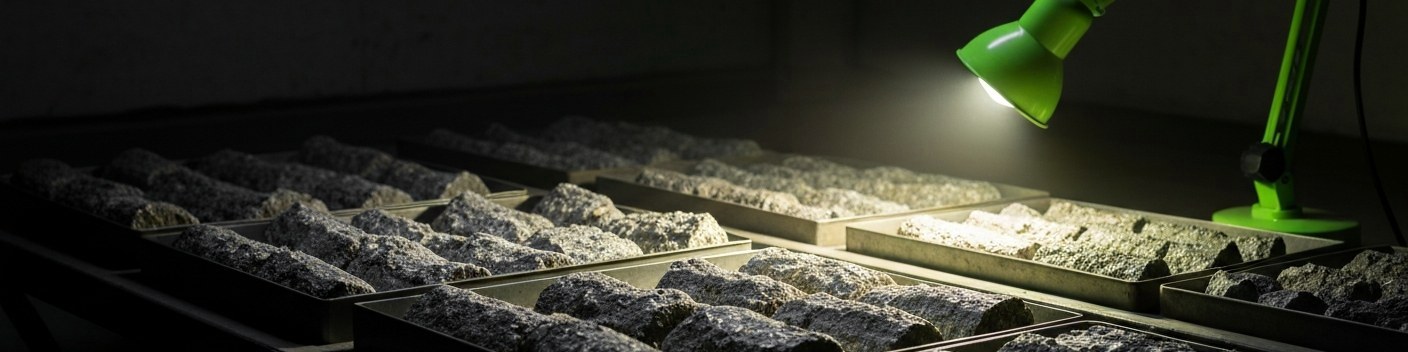
 Symbolbild · KI-generiert
Commodities & Mining stocks: small caps at a glance
What belongs in this sector
The sector includes companies that explore for, extract, and process mineral commodities — from precious metals such as gold and silver to industrial metals such as copper, lithium, and nickel, through to coal, phosphate, and rare earth elements. Their business model is straightforward: they produce commodities at a given cost of production and sell them at the prevailing world market price. Since the directory predominantly features small and mid caps, there are a particularly large number of exploration companies here — that is, companies that do not yet operate a producing mine but are instead identifying and proving up deposits. The value of such companies therefore depends almost entirely on the hope of future production.
What moves the share price
These are the events that typically move share prices in the Commodities & Mining sector:
The key figures that matter here
| All-in Sustaining Cost (AISC) | The AISC shows what it actually costs a company to produce one unit of a commodity (e.g. one ounce of gold) in full and to keep the mine running — including all ongoing capital expenditure. The smaller the gap between the AISC and the current market price, the more vulnerable the company is to price declines. |
|---|---|
| Resource and reserve classification | Mining makes a strict distinction between whether a deposit is merely inferred (Inferred Resource), geologically delineated (Indicated/Measured Resource), or economically proven (Proven/Probable Reserve). Only reserves may serve as a reliable basis for production plans, whereas resources still carry considerable uncertainty. |
| Net Asset Value (NAV) per share | The NAV calculates the estimated present value of all future cash flows from the deposits, less any debt — it is regarded as the central valuation measure in the mining sector. When a share trades at a significant discount to NAV (e.g. 0.5× NAV), this signals either scepticism about the estimates or elevated risk. |
| Leverage and liquidity buffer | Mining companies require enormous upfront investment over many years before a mine generates any revenue — a high level of debt combined with falling commodity prices can quickly lead to insolvency. For small caps in particular, the cash balance relative to the annual cash outflow (known as the cash runway) should be monitored closely. |
Risiken des Sektors
Companies in this sector
1473 listed small and micro caps in this sector, ordered by market capitalisation.
| companies | Ticker | Börse |
|---|---|---|
| Mullen Group Ltd. | MTL | TSX |
| Vermilion Energy Inc. | VET | TSX |
| Westshore Terminals Investment Corporation | WTE | TSX |
| TerraVest Industries Inc. | TVK | TSX |
| Energean Plc | ENOG | LSE |
| Snowline Gold Corp. | SGD | TSX |
| Parex Resources Inc. | PXT | TSX |
| LunR Royalties Corp. | LUNR | TSX |
| Kosmos Energy | KOS | NYSE |
| AbraSilver Resource Corp. | ABRA | TSX |
| Befesa | Frankfurt | |
| Mineros S.A. | MSA | TSX |
Andere Sektoren
Educational content only, not investment advice. Small caps are highly speculative and total loss is possible. All information without warranty.