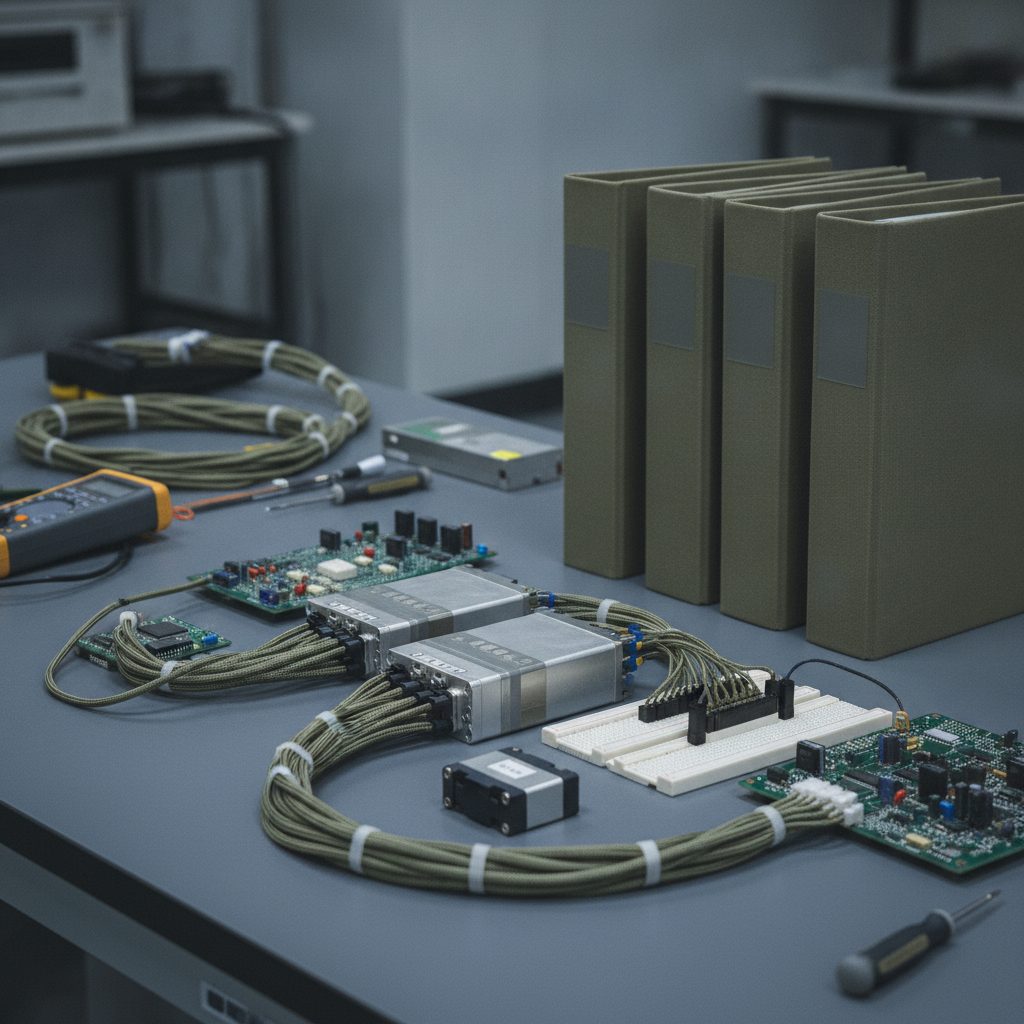
 Symbolbild · KI-generiert
Qualified Vendor Status: How Drone Procurement Selects Suppliers

When a Drone Concept Makes Procurement Logic Visible
With its "Wildfire" drone concept, General Atomics has submitted a proposal for the Massed Modular Aircraft program (MMA), jointly overseen by the U.S. Air Force and the Defense Innovation Unit (DIU). The program aims to develop a successor to the MQ-9A Reaper — the platform that has served as the backbone for long-endurance surveillance and precision strikes for more than two decades. At the same time, the director of the DAWG initiative (a Trump administration initiative continuing the Biden-era Replicator program for the mass procurement of low-cost drones) publicly warned of an impending funding interruption that could jeopardize the momentum built so far. And the U.S. Army has selected teams led by Lockheed Martin, Boeing, and Anduril for the next phase of the IFPC Inc 2 competition.
Three headlines, one common thread: they reveal how U.S. defense procurement works — and where specialized suppliers find opportunities, but also significant risks. For investors in defense small caps, a closer look at the mechanics behind these award processes is well worth the effort.
Certification Hurdles for Defense Suppliers (Difficulty Level (1–5))
The Defense Procurement Pyramid
U.S. defense programs follow a clearly structured hierarchy. At the top are so-called prime contractors or Tier-1 providers: large, established companies such as General Atomics, Lockheed Martin, Boeing, or Northrop Grumman. They bear contractual responsibility to the Pentagon and handle systems integration — assembling all components into a deployable platform.
Beneath them lies a broadly diversified supplier structure. Tier-2 and Tier-3 providers supply specialized subsystems: electro-optical sensors, communications links, propulsion units, mission-planning software, data-fusion modules, or ground control systems. Many of these providers are small or mid-sized companies — precisely the segment referred to in equity markets as "defense small caps."
The critical question is: At which level can a company participate in these programs? The answer depends less on product quality than on a status characteristic that is frequently underestimated.
What Approved Vendor Status Means in Practice
The Pentagon's U.S. procurement system — governed by the Federal Acquisition Regulation (FAR) and supplementary defense regulations (DFARS) — requires suppliers to maintain complete traceability of materials, manufacturing processes, and quality-assurance protocols. Added to this are cybersecurity requirements under the CMMC framework (Cybersecurity Maturity Model Certification), which have been phased in as mandatory requirements since 2024.
For a small-cap company, this means: even if its product — say, a miniaturized sensor system or an AI-powered ground control module — is technically a perfect fit for the MMA program's requirements, participation in the supply chain cannot begin until all certification steps are complete. This process consumes time and capital without generating any program revenue in the interim.
An analogous pattern is well known from aerospace supply chains: AS9100 certification (the quality management standard for the aviation industry) is a baseline prerequisite simply to enter the selection pool of larger OEMs. Companies without it are excluded — regardless of price or technology. In the defense sector, the entry barrier is even higher due to national-security requirements.
Another example illustrates the time dimension: when the U.S. Army awarded the IVAS program (Integrated Visual Augmentation System) for augmented-reality helmets in 2019, it took several years to build the ecosystem of qualified suppliers for optical components and display modules. For small caps that had invested early in the qualification process, real call-off orders eventually materialized — for those who arrived too late, only the aftermarket remained.
| Status Feature | Significance for the Supplier |
|---|---|
| QPL/QML Entry (Qualified Products/Manufacturers List) | Formal approval for specific components; prerequisite for a direct contract or subcontract |
| CMMC Certification (Level 2 or 3) | Mandatory for sensitive defense programs; being phased in as compulsory from 2025 onward |
| ITAR Registration | Required for the export or transfer of defense-relevant technology; extensive compliance structure |
| Framework Agreement (IDIQ or BPA) | Sets a ceiling on the maximum callable volume; no guaranteed revenue — individual call-offs are placed separately |
Attritable Drones, DAWG, and the Funding Gap
Running in parallel to long-term development programs like the MMA successor to the Reaper, a second procurement logic exists: the mass production of low-cost "attritable" drones — systems deliberately designed to be expendable in combat. The Biden-era Replicator initiative aimed to procure thousands of such drones; the Trump administration continued this logic under the DAWG framework.
Here, the DAWG director publicly warned of the consequences of a funding pause: not only would active contracts stall — it would also endanger the supplier network that had been painstakingly assembled. Attritable drones rely on standardized, cost-efficiently produced modular components. Suppliers that have built production capacity for these systems face the problem of stranded investment and a lack of alternative customers if a program is halted — a structural risk that investors should understand.
This pattern is familiar from other sectors: a solar-cell manufacturer that has aligned its entire capacity to a single large offtake partner sits in a comparable dependency. Customer portfolio diversification is also a central quality criterion when evaluating small caps in the defense supply space.
What Investors Can Derive from Procurement Logic
The interplay of the MMA program, the DAWG initiative, and the IFPC Inc 2 competition illustrates a core principle of modern defense procurement: the big headlines go to the prime contractors, but the real distribution of value creation lies deeper in the supply chain. For small-cap investors, this means the relevant questions are not "Who wins the prime contract?" but rather:
- Is the company already listed as a qualified supplier on relevant programs?
- What share of revenues comes from firm call-off orders — as opposed to letters of intent or framework agreements?
- How large is the dependence on a single program or customer?
- How long does the cash runway last to bridge a certification phase without incoming revenue?
A company that holds Approved Vendor status for safety-critical drone components and can point to call-off orders under an IDIQ contract is structurally in a very different position than a competitor whose technology is still in the qualification phase — even if both develop similar products. This distinction is often not immediately visible on stock markets, but it is reflected in revenue quality over the medium to long term.
For investors researching this segment, a critical reading of company announcements is worthwhile: Is what is being communicated a "strategic agreement" with a prime contractor, or is there already a concrete subcontract with a defined call-off volume in place? The difference is legally and financially significant — and a frequent source of disappointment when reality catches up with expectations.
Defense Procurement: Key Terms for Beginners
- Prime Contractor (Tier 1)
- The company that holds the primary contract with the Department of Defense and is responsible for systems integration. Examples: General Atomics, Lockheed Martin, Boeing.
- Qualified Products List (QPL) / Approved Vendor
- The Pentagon's formal list of vetted and approved suppliers for specific components. Without an entry, a company has no access to government contracts in that area.
- IDIQ Contract (Indefinite Delivery, Indefinite Quantity)
- A framework agreement with a defined maximum volume from which individual orders (call-offs) are placed. No call-off means no revenue — a common misconception among investors.
- Attritable Drone
- A drone produced cheaply enough that its loss in combat is factored into the operational calculus. The focus is on mass production speed and volume, not on preserving individual unit value.
- CMMC (Cybersecurity Maturity Model Certification)
- A U.S. certification framework for cybersecurity that is being phased in as mandatory for all companies in the defense supply chain. Multiple maturity levels (Level 1–3).
- Cash Runway
- Cash on hand divided by monthly expenditures (burn rate). Indicates how many months a company can survive without new revenue or a capital increase. A critical metric for unprofitable small caps.
- Book-to-Bill Ratio
- Order intake divided by recognized revenue over a given period. A value above 1 signals order growth; below 1 indicates a slowdown. An important leading indicator in defense supply chains.
- ITAR (International Traffic in Arms Regulations)
- U.S. export control regulations governing defense technology. Companies that manufacture ITAR-relevant components require government registration and are subject to strict compliance requirements.
⚠️ Important notice: This article is for informational and educational purposes only. It does not constitute investment advice, a recommendation, or a solicitation to buy or sell any security. Investments in small-cap exploration and mining companies carry a high risk, including the potential total loss of capital. Before making any investment decision, consult a registered financial advisor and conduct your own analysis. Aktienatlas-Redaktion is not responsible for decisions taken based on the content published here.
Educational content only, not investment advice. Small caps are highly speculative and total loss is possible.