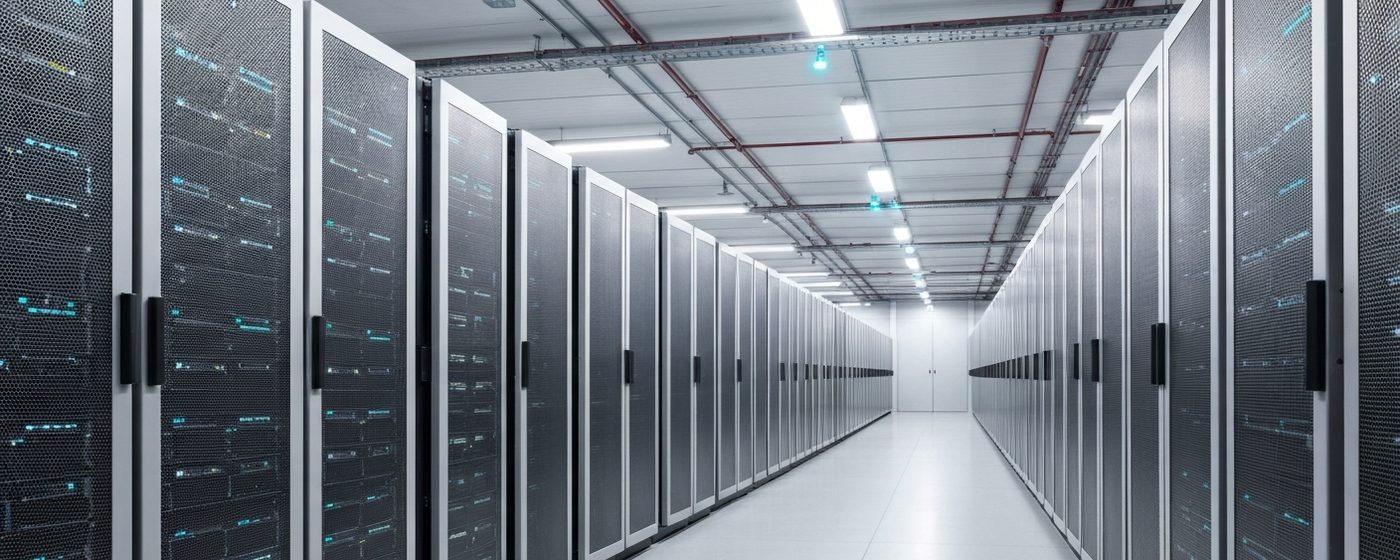
 Symbolbild · KI-generiert
When Infrastructure Becomes an AI Business Model: What Investors Need to Know
More Revenue from Data Centers Than Rockets — A Structural Signal
When people think of SpaceX, they think of rockets, satellites, and space stations. The fact that the company — according to internal quarterly figures — now generates approximately $2.6 billion in revenue from selling AI compute capacity to third-party companies, surpassing its classic space division for the first time, is no coincidence. It is a structural signal that points far beyond this individual case.
What is emerging here is a pattern investors should understand in a broader context: companies with physical infrastructure — compute capacity, energy supply, networks, cooling systems — are becoming sought-after partners in the AI ecosystem. The boundaries between sectors are blurring. And for investors in small caps, this creates a new category of questions: Which smaller companies stand to benefit from this shift? And what risks does the capital intensity of these business models bring?
SpaceX AI Revenue vs. Prior Year (rounded) (USD bn)
Why Physical Infrastructure Is Suddenly Scarce in the AI Era
Large language models and other AI systems require enormous amounts of computing power — especially during training, the process by which a model is fed billions of data points in order to recognize patterns. This computational work runs on specialized chips (primarily GPUs and TPUs) that are clustered together in data centers.
The problem: such infrastructure cannot be scaled up quickly. Building a data center with adequate cooling, power supply, and network connectivity takes years and costs hundreds of millions to several billion dollars. This creates a scarcity dynamic: whoever already has these resources — regardless of their original sector — can lease or sell them to AI companies.
SpaceX is illustrative here, but not a unique case. Utilities, telecommunications companies, and industrial groups with large proprietary computing infrastructure face a similar strategic opportunity. Some analysts already speak of an "infrastructure premium": companies that can offer compute capacity are increasingly being valued by markets like technology companies — even if their original business was something entirely different.

Sector Blurring and Its Consequences for Small-Cap Valuation
For small-cap investors, sector blurring is particularly relevant — and particularly risky. When a small company, originally known as a defense supplier, satellite operator, or network service provider, announces its intention to offer AI compute capacity, this can trigger a significant revaluation by the market. The stock is suddenly traded at AI multiples, even though the core business remains unchanged.
This is a familiar pattern from stock market history: during the dot-com era of the late 1990s, simply adding the word "Internet" to a company name or press release was often enough to drive the share price sharply higher in the short term — regardless of the actual business model. An analogous dynamic is observable today with companies announcing "AI" or "compute" as a new pillar. Investors should therefore distinguish: is this a genuine, measurable revenue contribution from an infrastructure business — or merely a statement of strategic intent with no concrete order backlog?
This is precisely where a common misconception lies: a partnership or pilot project is not billable revenue. The relevant question is: are there already signed contracts with specific volume commitments, or is this a letter of intent that still needs to be converted into firm orders?
| Distinction | What it means |
|---|---|
| Letter of Intent (LoI) | Not a legally binding order; no guaranteed revenue |
| Framework agreement | Covers maximum order volume — without a firm call-off obligation |
| Firm order intake | Binding purchase order; enters the order backlog |
| ARR (Annual Recurring Revenue) | Recurring annual revenue; a more stable signal than one-off transactions |
Capital Intensity: The Silent Risk Behind the AI Infrastructure Boom
Building compute infrastructure requires massive upfront investment — chips, buildings, power, cooling. For large companies with strong balance sheets, this is manageable. For small companies, it can be existentially threatening.
The central concept here is cash runway: if a company has, for example, €20 million in cash and spends €2 million per month, it has a runway of ten months. If that time is insufficient to bring the infrastructure online and generate revenue, new capital must be raised — through a capital increase (share issuance), in which new shares are issued. This dilutes existing shareholders' stakes and can put pressure on the share price.
A further risk is dependence on a small number of large customers. If a small cap derives 80 percent of its compute revenue from a single AI company and that contract is not renewed, revenue can collapse overnight. These concentration risks are often explicitly disclosed in company reports — for example, in the "Risk Factors" section of a prospectus — but they rarely make the headlines.
There is also the issue of margin pressure: compute infrastructure is a commodity business. Any company that fails to differentiate through specialization, a location advantage (e.g., proximity to cheap renewable energy), or a technological edge will find itself in a price war with capital-rich hyperscalers such as Amazon, Microsoft, or Google.
What the SpaceX Case Means for Reading the Market
The SpaceX case is instructive not because of its uniqueness, but because of its exemplary nature. It demonstrates that sector classifications on the stock market are increasingly losing their precision. A company that would be listed in an index as "Aerospace & Defense" may in practice generate the majority of its revenue from AI infrastructure. This has consequences for valuation methodology: with what multiple does one value a company that is 40 percent aerospace and 60 percent compute?
For investors in small caps, a consistently source-based approach to analysis is advisable: What is the actual revenue share from the new segment? How is it underpinned by contracts? How long does the cash runway extend before the new business pillar must become profitable? And how significant is the dilution risk from planned capital increases?
The answers to these questions are not always easy to find — but they are contained in published company announcements, quarterly reports, and prospectuses. Those who read them before investing make better-informed decisions.
Key Terms in AI Infrastructure Investing
- Compute
- An umbrella term for the processing power required to train and operate AI models. Often measured in GPU-hours or FLOPS (floating-point operations per second).
- Cash Runway
- The number of months a company can sustain operations with its current cash balance at a constant burn rate, without raising new capital. Formula: cash balance ÷ monthly burn rate.
- Capital Increase / Dilution
- The issuance of new shares to finance business operations. While it raises available capital, it reduces the percentage ownership stake of existing shareholders.
- ARR (Annual Recurring Revenue)
- Annually recurring revenue from ongoing contracts or subscriptions. Considered a more stable quality indicator than one-off project revenue.
- Letter of Intent (LoI)
- A non-binding declaration of intent to pursue a collaboration or contract. It does not constitute billable revenue or order intake — and is frequently overestimated by market news coverage.
- Infrastructure Premium
- The valuation premium markets award to companies that can provide scarce physical infrastructure (e.g., compute capacity, energy supply) for AI operations.
- Hyperscaler
- Very large cloud providers such as Amazon Web Services, Microsoft Azure, or Google Cloud, which operate global compute infrastructure at industrial scale and frequently act as competitors to smaller compute providers.
⚠️ Important notice: This article is for informational and educational purposes only. It does not constitute investment advice, a recommendation, or a solicitation to buy or sell any security. Investments in small-cap exploration and mining companies carry a high risk, including the potential total loss of capital. Before making any investment decision, consult a registered financial advisor and conduct your own analysis. Aktienatlas-Redaktion is not responsible for decisions taken based on the content published here.
Educational content only, not investment advice. Small caps are highly speculative and total loss is possible.