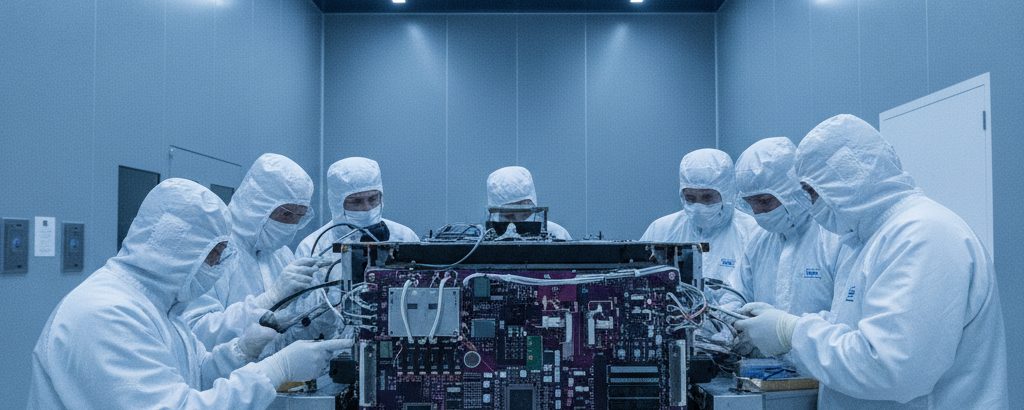
 Symbolbild · KI-generiert
Radiation-Hardened Chips: Why On-Board Computers in Orbit Are Becoming Scarce
When the Satellite Has to Think for Itself
A single next-generation Earth observation satellite generates several terabytes of raw data every day. Radio links to ground stations are limited, and latencies for time-critical applications — such as military reconnaissance or collision avoidance — are simply too long. The logical consequence: filtering, compressing, and interpreting data must increasingly happen directly in orbit. This principle is called edge-processing — and it is fundamentally changing the hardware requirements for satellites.
What once only needed to be handled by a compute node consuming a few watts must today run complex algorithms for image recognition, signal processing, and autonomous decision-making — in an environment where cosmic radiation can flip individual transistors in integrated circuits at any moment. The on-board computer as the weakest link in the chain: this is not a technical footnote, but a growing market for specialized semiconductor manufacturers.
Qualification Duration: COTS vs. Rad-Hard Chips (Months)
Mega-Constellations as a Growth Driver — and System Stress Test
Just a few years ago, satellite constellations with single- or double-digit satellite counts were the norm. Today, commercial and government operators are planning networks of hundreds or even thousands of units in Low Earth Orbit (LEO). These mega-constellations are changing system architecture on several levels simultaneously.
First, total system data throughput is growing exponentially. Second, the complexity of the threat environment is increasing: more satellites mean more potential attack surfaces for electronic jamming, spoofing, or cyberattacks on control channels. Third, the density of objects in orbit raises the demands on autonomous collision avoidance — a process that requires millisecond response times and therefore cannot wait for a ground station.
All of these factors converge in a single demand on hardware: more computing power per watt, directly on board, under extreme radiation conditions. Conventional commercial chips — so-called COTS components (Commercial Off-The-Shelf) — are only partially suited for this purpose. They can suffer sporadic bit-flip errors that have fatal consequences in safety-critical applications.
What Sets Radiation-Hardened Chips Apart from Conventional Semiconductor Technology
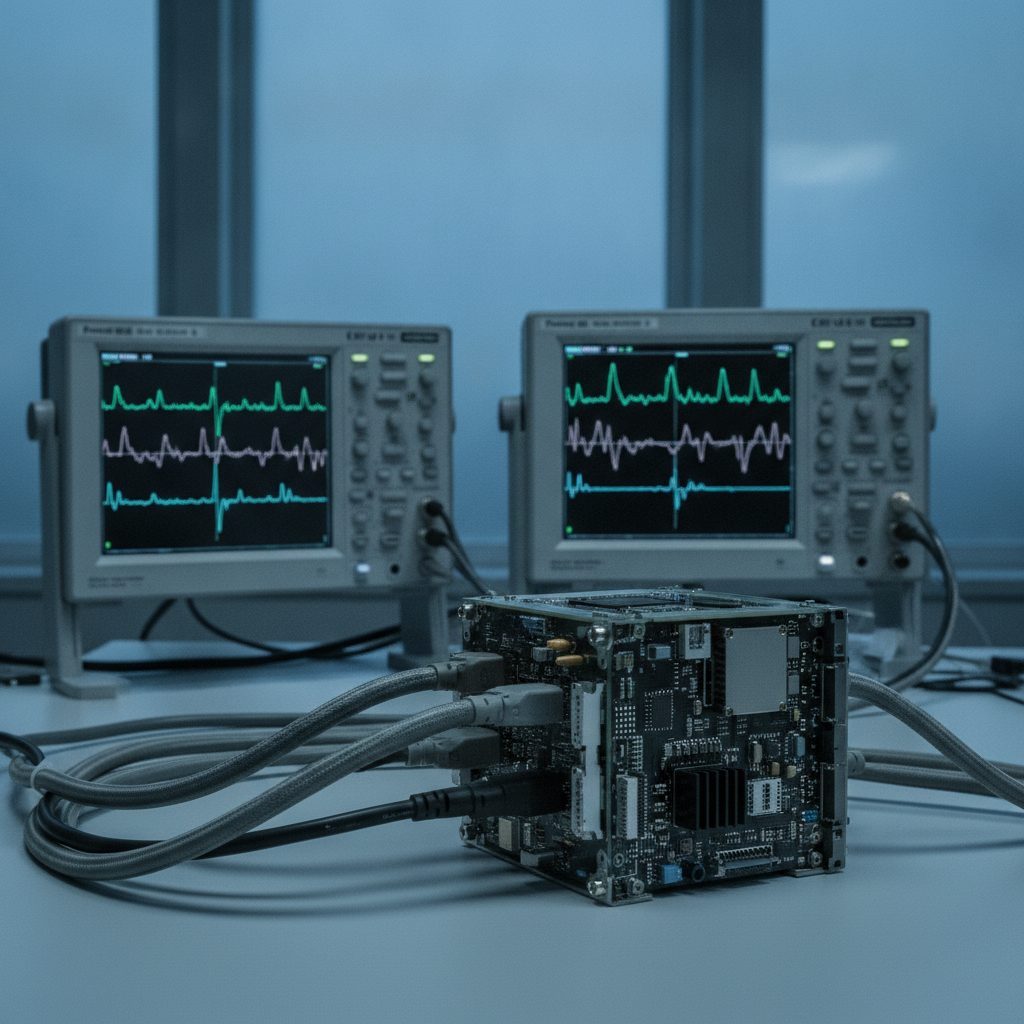
The term radiation hardening describes a group of techniques that make semiconductors resistant to ionizing radiation. This is achieved in two ways: through the selection of specialized manufacturing processes (Radiation Hardening by Process, RHBP) or through specific circuit architectures (Radiation Hardening by Design, RHBD) that can detect and correct errors.
Both approaches are demanding. They require specialized production lines or design methodologies that differ from commercial chip development. This makes radiation-hardened chips more expensive — but above all: harder to qualify. Before a chip may be used in a government satellite or a safety-critical communications system, it must pass extensive testing under standards such as MIL-STD-883 or ESA/ESCC. These qualification cycles typically take 18 to 36 months.
For small-cap suppliers, this timeframe is capital-intensive: development and testing costs accumulate before a single chip can be invoiced. On the other hand, a successfully completed qualification cycle creates a high barrier to entry for competitors. Once a company is listed as a Qualified Manufacturer on a procurement list, it enjoys structural competitive advantages for many years — defense agencies very rarely switch qualified suppliers.
| Criterion | Commercial Chips (COTS) | Radiation-Hardened Chips |
|---|---|---|
| Qualification duration | Weeks to months | 18–36 months |
| Unit price | Low (mass production) | High (specialized manufacturing) |
| Radiation tolerance | Low (not designed for it) | High (tested per MIL/ESA standards) |
| Supplier switching by customers | Frequently possible | Structurally rare |
| Typical application | Consumer electronics, cloud | LEO/GEO satellites, military |
Capital Requirements, Dilution Risk, and Structural Advantages in Balance
For investors monitoring small-cap suppliers in this segment, a characteristic risk profile emerges: the entry phase leading up to supplier qualification ties up substantial capital without generating immediate revenue. Companies without an equity buffer or public funding often need to finance themselves through capital increases (share issuances) — which burdens existing shareholders through dilution.
The mechanics are always the same: new shares are issued to raise fresh capital. This increases the total number of shares outstanding — and thereby reduces the percentage ownership stake of every existing shareholder. Over a long qualification phase, several such rounds may be necessary. The cash runway — that is, the number of months a company can sustain operations with its current liquid assets and monthly expenditure rate (burn rate) — is therefore one of the most important metrics during this development phase.
Once a company has cleared the qualification hurdle, the picture reverses: long-term framework agreements secure predictable revenues over several years. Defense agencies and satellite operators prefer stable supply chains, which is also where the book-to-bill ratio comes into play — the ratio of order intake to revenue. If the book-to-bill ratio remains consistently above 1.0, the order backlog is growing, providing an indication of future earnings.
An important distinction must be made between a framework agreement (which sets a total volume but contains no binding individual call-offs) and a firm purchase order (which defines specific delivery quantities and due dates). Press releases often blur this line — critical reading is essential.
What Edge-Processing in Orbit Means for Investors
The radiation-hardened on-board computing segment is not a fast-rotating trend topic, but a structural growth driver with long cycles. The rising number of LEO satellites — from both commercial programs and military procurement initiatives — creates sustained demand for precisely those components that only a handful of specialized manufacturers can supply.
For investors, several observations follow:
- Companies already listed on qualification registers hold a competitive advantage that is difficult to attack — but the market is small and often illiquid.
- Companies still in the qualification phase carry high dilution risk and an uncertain timeline to their first reliable revenue.
- Government funding programs (for example from ESA, NASA, or the U.S. Department of Defense) can shorten the cash flow gap during the qualification phase — but approved grants are not the same as disbursed grants.
- A total loss of capital is possible in this segment if a company fails the qualification hurdle, runs out of capital, or loses a customer contract unexpectedly.
Terms Investors in This Segment Should Know
- Edge-Processing
- Data processing directly at the point of origin — in the context of satellites: computing operations that take place on board rather than sending raw data to Earth. Reduces latency and bandwidth requirements.
- Radiation Hardening
- Techniques at the chip or circuit level that protect integrated circuits against bit-flip errors caused by cosmic radiation and high-energy particles. A prerequisite for use in space missions.
- COTS (Commercial Off-The-Shelf)
- Commercially available standard components not specifically developed for space applications. Cost-effective and high-performance, but generally not qualified for high radiation environments.
- Qualification Cycle
- A comprehensive testing process that a component must pass before it may be used in safety-critical space or defense systems. Typically takes 18–36 months and incurs significant upfront costs.
- Cash Runway
- The number of months a company can sustain operations with its current cash balance and monthly burn rate before it requires additional funding. The shorter the runway, the higher the dilution risk.
- Book-to-Bill
- The ratio of order intake to revenue in a given period. A value above 1.0 means more orders are coming in than are being shipped — the order backlog is growing.
- Framework Agreement vs. Firm Purchase Order
- A framework agreement defines an overall potential (maximum quantity or value) but contains no delivery obligation. Only a firm purchase order commits to delivery and gives rise to invoiceable revenue.
- Dilution
- Occurs when a company issues new shares to raise capital. The percentage ownership stake of existing shareholders decreases, which — assuming a constant company value — reduces the value per share.
⚠️ Important notice: This article is for informational and educational purposes only. It does not constitute investment advice, a recommendation, or a solicitation to buy or sell any security. Investments in small-cap exploration and mining companies carry a high risk, including the potential total loss of capital. Before making any investment decision, consult a registered financial advisor and conduct your own analysis. Aktienatlas-Redaktion is not responsible for decisions taken based on the content published here.
Educational content only, not investment advice. Small caps are highly speculative and total loss is possible.