 Symbolbild · KI-generiert
Optical Laser Links in Space: From Demo to Business Model
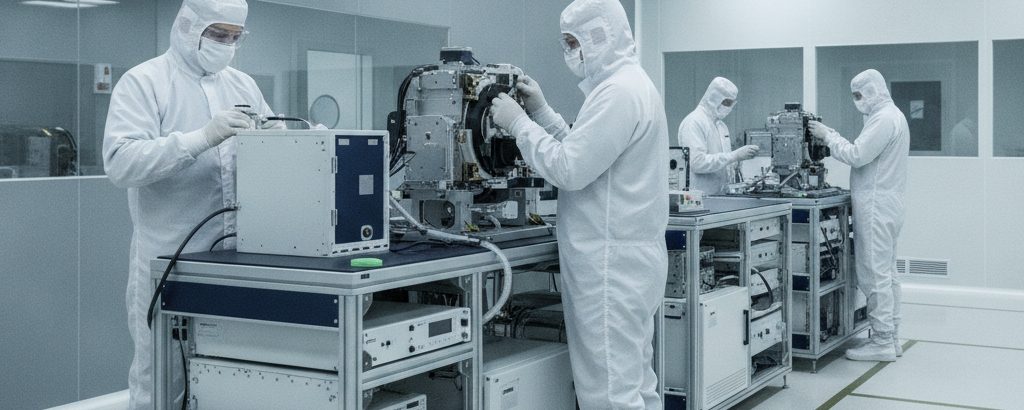
Laser Beam vs. Radio Wave: How Optical Communication Is Changing Space
In space, one simple rule applies: whoever can transmit data faster and more securely wins. Conventional radio-frequency systems are increasingly hitting their limits — bandwidth is scarce, frequency spectrums are congested, and eavesdropping protection is difficult to guarantee. Optical laser communication, also known as Free-Space Optical Communication (FSOC), offers a solution. Instead of radio waves, data packets are transmitted as focused beams of light — delivering significantly higher bandwidth, lower latency, and a naturally narrow beam directionality that makes interception considerably harder.
That this technology no longer exists only in the lab is illustrated by a recent partnership: Lithuanian start-up Astrolight and space company ATMOS Space Cargo have signed a Memorandum of Understanding (MOU). The goal is to demonstrate, for the first time in flight, an optical link between a reentry vehicle and a satellite. Such a demo would carry real technological significance — but for investors, the real analysis starts precisely at this point.
Development Stages: Demo to Series Contract (Stage 1–5)
The Laser Communication Market: Why the Timing Is No Coincidence
The context of this demo should not be viewed in isolation. Space agencies and commercial operators worldwide are actively working to integrate so-called Optical Inter-Satellite Links (OISL) into their constellations. NASA has tested its own laser links with the LCRD system. European institutions are funding similar initiatives. And the commercial sector is following suit.
Kepler Communications, for example, has reportedly booked launches on Rocket Lab's Neutron rocket for 2028 to deploy next-generation optical relay satellites. This shows that what today still looks like a niche demonstration could become the standard architecture for larger constellations within just a few years. The question is not whether, but when — and which companies will still be viable by then.
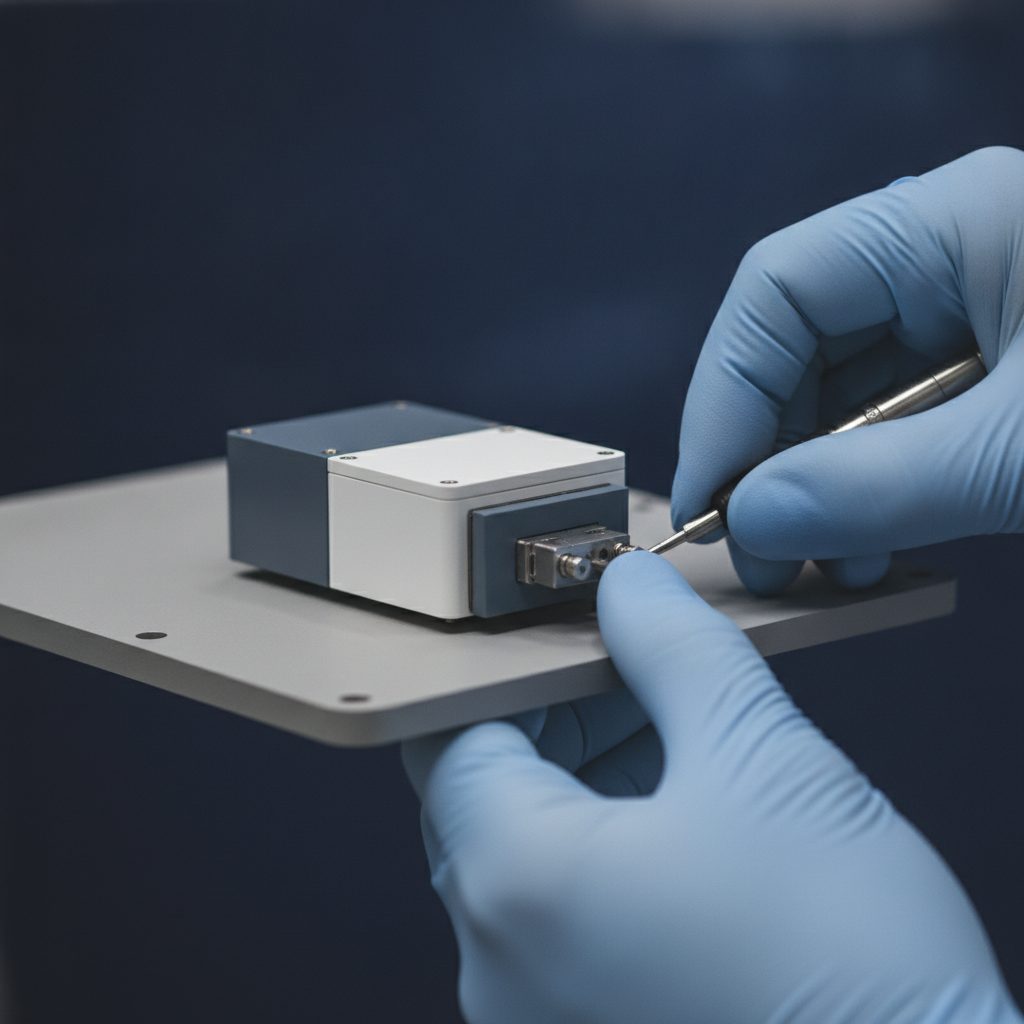
From Letter of Intent to Order Book: How the Transition Succeeds — or Fails
Technology demonstrations typically pass through several stages before becoming real revenue sources. This dynamic can be illustrated with a simple analogy: an architect who builds a model house has not yet sold a house. Only the construction contract with a paying customer counts as an order. The same principle applies in the space sector.
The typical development chain looks like this:
| Stage | Meaning for Investors |
|---|---|
| MOU / Letter of Intent | No revenue; signal of technical interest |
| In-Flight Technology Demo | No revenue; milestone for grant applications and investors |
| Pilot Contract / First Order | First measurable revenue; often at preferential terms |
| Framework Agreement (IDIQ / Call-off Contract) | Ceiling volume with no guaranteed call-off |
| Firm Call-off / Series Contract | Bankable order intake; relevant for valuation |
Small-cap companies like Astrolight are frequently at the first two stages. That means they depend on research grants, venture capital, and strategic partnerships — not on operating cash flow. In this phase, cash runway — the time a company can sustain operations with its current cash balance at its ongoing burn rate — is the most critical metric. If the runway falls short of the next milestone, the company faces either a capital increase (share issuance) that dilutes existing shareholders, or — in the worst case — insolvency.
Kepler Communications illustrates what a later stage can look like: the company has made concrete launch bookings and communicated a planned deployment window. That is no guarantee of success, but it is a considerably more solid foundation than an MOU. Even so, the distance to operating profitability remains substantial.
Three Questions Investors Should Ask About Every Space Demo
Technology demonstrations frequently attract media attention and can trigger price movements — especially for thinly capitalized companies with no profits. That makes them interesting for speculative investors, but also dangerous. Three guiding questions help assess the substance behind such an announcement:
1. Who is paying for the demo? If a public funding body or a partner is covering the costs, that secures near-term operations but says little about the willingness of commercial customers to pay. Self-funded demos, on the other hand, signal conviction — and a commitment of capital.
2. What is the next concrete step? An MOU with no defined timeline for a pilot contract is weaker than one with a clear milestone path. Investors should look for binding follow-on steps that are communicated publicly.
3. How long does the capital last? If the cash runway is shorter than the time to the planned demo, a capital increase is likely. This dilutes existing shareholders and can put pressure on the share price — even if the demo succeeds technically.
What Laser Communication Means for the Space Sector Long Term
Regardless of the fate of individual companies, a structural trend is taking shape: optical communication in space is becoming more relevant — for military applications as much as for commercial constellations. Agencies such as the U.S. Space Development Agency have already defined OISL as a standard requirement for future satellite generations. This creates a long-term demand pull that could theoretically benefit early technology providers.
However, the iron rule of startup economics applies here too: the first mover does not win automatically. Completing the demo does not mean winning the market. Understanding the market but running out of capital still means losing. And anyone competing directly against established players must explain why their approach makes the difference — and at what price.
For investors, this means: the partnership between Astrolight and ATMOS Space Cargo is a legitimate signal of technology development in a growing segment. It is not a buy signal, not proof of revenue, and not evidence of commercial-scale competitiveness. The gap between a flying demo and a profitable business model is especially wide in the space sector — and especially costly.
Key Terms for Beginners
- Memorandum of Understanding (MOU)
- A legally non-binding letter of intent between two parties, signaling interest in a collaboration. Not a contract, not an order intake, not secured revenue.
- Free-Space Optical Communication (FSOC)
- Transmission of data via focused light beams (lasers) through open space, without fiber-optic cables. In space, this enables high bandwidth and directional, hard-to-intercept connections.
- Cash Runway
- The period of time a company can continue operating with its current cash balance at a constant burn rate before new capital is required. The most important survival metric for unprofitable start-ups.
- Burn Rate
- The monthly net cash outflow of a company that generates little or no revenue. High burn rate + short runway = elevated dilution risk.
- Capital Increase / Dilution
- When a company issues new shares to raise fresh capital, existing shareholders' stake in the overall company decreases. This effect is called dilution and can weigh on the share price.
- Framework Agreement vs. Firm Call-off
- A framework agreement sets maximum delivery volumes but does not obligate the client to place any orders. Only a firm call-off (individual purchase order) establishes a bookable order intake.
- Optical Inter-Satellite Link (OISL)
- A laser-based connection directly between satellites in orbit, bypassing ground stations. Enables real-time communication even in remote regions without ground infrastructure.
⚠️ Important notice: This article is for informational and educational purposes only. It does not constitute investment advice, a recommendation, or a solicitation to buy or sell any security. Investments in small-cap exploration and mining companies carry a high risk, including the potential total loss of capital. Before making any investment decision, consult a registered financial advisor and conduct your own analysis. Aktienatlas-Redaktion is not responsible for decisions taken based on the content published here.
Educational content only, not investment advice. Small caps are highly speculative and total loss is possible.