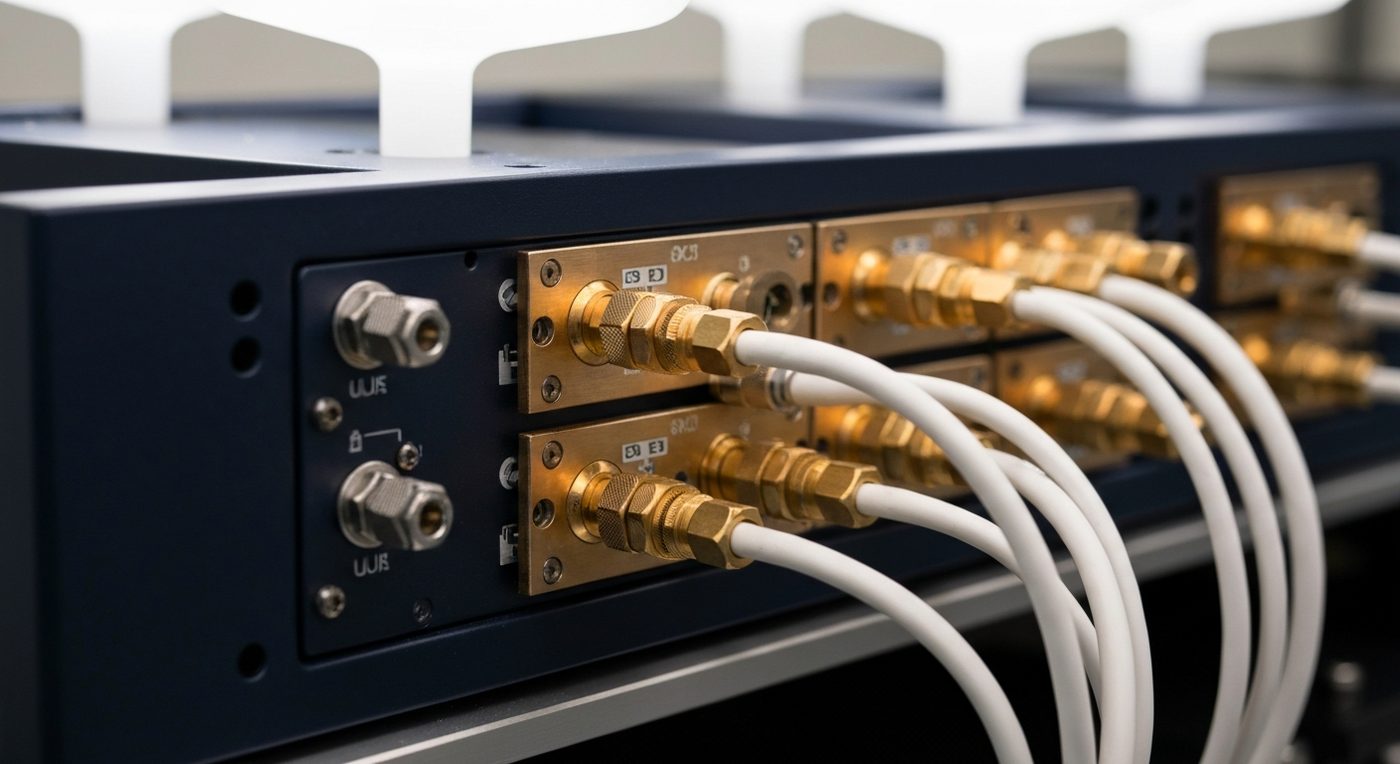
 Symbolbild · KI-generiert
Narrative vs. Fundamentals: What QUBT Investors Underestimate

When Hype Energy Jumps Sector Boundaries
Quantum Computing Inc. (Nasdaq: QUBT) is not an AI company. Yet the stock is regularly pulled into the AI narrative — because investors, media outlets, and algorithms search for buzzwords and blur sector boundaries in the process. This phenomenon is not unique: in every technology hype cycle, there are companies that benefit from the attention surrounding a hot adjacent theme without being at its core.
For newcomers to the small-cap space, this pattern is particularly instructive. It illustrates how price movements can emerge that cannot be explained by quarterly figures, contract announcements, or product progress — but solely by the power of a story. The problem: narrative-driven rallies often end abruptly when operating reality reasserts itself.
Three Evaluation Criteria for Quantum Small Caps (Priority (1–3))
Quantum Computing and AI — Neighbors, Not Twins
Quantum computing and artificial intelligence share a superficial similarity: both are considered key technologies of the next decade and receive extensive media coverage. Technologically and economically, however, they are fundamentally different. AI — particularly generative models — runs today on conventional GPU hardware and already generates measurable revenue for software providers. Quantum computing, by contrast, is still in a phase where error correction, qubit stability, and scalability remain unsolved foundational problems.
It is understandable why investors conflate the two topics: a quantum computer could theoretically solve certain optimization problems that are also relevant to AI applications. That "could," however, is decisive. Between a potential use case and a billable product often lie years — sometimes decades — of development work.
A historical analogy: when the internet became a hype topic in the late 1990s, cable companies and satellite operators also briefly benefited from the euphoria. Many of those companies, however, had no viable business models for the new era — and lost the bulk of their market value in the subsequent correction.
The Three Checkpoints Behind a Price Impulse
Anyone wanting to assess a quantum computing company like QUBT after a narrative-driven price surge should ask three core operating questions:
| Evaluation Criterion | What It Reveals |
|---|---|
| Annual Recurring Revenue (ARR) | Are there stable customer relationships generating real cash flows — or do one-off contracts and public funding / grants dominate? |
| Cash Runway | How many months can the company operate at its current cash balance and burn rate before new capital is required? |
| Contract Pipeline vs. Letters of Intent | Are the announced partnerships firm order calls or non-binding framework agreements with no guaranteed volume? |
These three questions can be applied to any speculative small cap — regardless of sector. They prevent investors from confusing a good story with a good company.
ARR vs. total revenue: Some quantum computing providers book one-off consulting services or government research grants as revenue. That is legitimate — but qualitatively different from recurring software revenue with a renewal option. The latter signals that customers are willing to pay on an ongoing basis.
Cash runway: For a company without profitability, cash runway is the most critical metric. If a company has, for example, 12 months of runway and is still far from breakeven, a capital increase (share issuance) is highly likely — which dilutes existing shareholders. The dilution mechanism works as follows: the company issues new shares to raise fresh capital. The total share count rises, each existing shareholder's percentage stake falls — and with it, their share of future company value.
Contracts vs. letters of intent: In the defense sector, experienced investors know the difference between a firm order call and an IDIQ framework agreement. Similar nuances exist in quantum computing: a "strategic partnership" with a large corporation is worthless as long as no billable order volume sits behind it. Only when cash flows begin does an announcement become revenue.
Why Narrative Rallies Are So Seductive
The human brain seeks patterns and stories — and market participants are no exception. When a sector like AI commands dominant attention, many investors reflexively transfer the positive sentiment to adjacent themes. The mechanism is well understood: search volumes rise, social media amplifies the signal, algorithms react to buzzwords — and suddenly a stock moves without any operational change having occurred.
Psychologists call this the "halo effect": the positive attributes of one topic (AI is powerful, forward-looking, lucrative) radiate onto adjacent companies. Quantum Computing Inc. already carries two key tech-investing buzzwords in its name — "Quantum" and "Computing" — which almost automatically attracts algorithmic attention.
The flip side of the halo effect becomes visible when the hot adjacent theme corrects: the companies that rode its coattails then lose disproportionately, because their price gains had no fundamental foundation. That is the symmetric risk of the narrative rally.
What This Pattern Means for Investors
The phenomenon surrounding QUBT is not an isolated case — it is a recurring market dynamic. Small-cap investors encounter it whenever a dominant technology narrative grips the market: during the blockchain era, companies that added "Blockchain" to their corporate names experienced short-lived price explosions regardless of their operating substance. Similar patterns played out in the metaverse cycle and in earlier AI waves.
The instructive core: a price increase is not proof of operational strength. Separating price movement from fundamentals is a core competency for anyone investing in speculative sectors. Investors who keep these two levels distinct are better positioned to differentiate between a genuine re-rating — driven by revenue growth, new contracts, or technological milestones — and a pure narrative wave.
It is worth noting: quantum computing is a real technology with serious scientific advances. The question is not whether, but when and by whom commercial scaling will succeed — and whether current market valuations already price in that uncertain timeline or overshoot it.
Speculative investing in small caps of this type carries significant risks. Beyond the dilution risk from capital increases (share issuances), a total loss of capital remains a realistic scenario — particularly if technology milestones are delayed, capital markets cool, or a competitor with superior resources occupies the same niche. This article does not constitute investment advice.
Key Terms at a Glance
- ARR (Annual Recurring Revenue)
- Revenue that recurs annually from active subscriptions or contracts. Considered qualitatively superior to one-off revenue because it reflects the stability of customer relationships.
- Cash Runway
- The period a company can sustain operations with its current cash balance at its existing burn rate before new capital is needed. Calculation: cash balance ÷ monthly burn rate = months remaining.
- Burn Rate
- The monthly net cash outflow of a company that has not yet reached profitability. The higher the burn rate and the shorter the runway, the more likely an imminent capital increase (share issuance).
- Dilution
- The reduction of existing shareholders' percentage ownership resulting from the issuance of new shares in a capital increase. Dilution lowers earnings per share and each shareholder's stake in future company value.
- Narrative Rally
- A price increase triggered not by operational improvements but by association with a popular theme. Typical during hype phases; often short-lived and reversible.
- Framework Agreement vs. Order Call
- A framework agreement defines terms and maximum volumes but does not commit the buyer to firm orders. Only a specific order call generates billable revenue.
- Halo Effect
- A cognitive bias in which the positive attributes of one theme (e.g., AI growth) are transferred to adjacent, only loosely related companies — with direct effects on their share price and trading volume.
⚠️ Important notice: This article is for informational and educational purposes only. It does not constitute investment advice, a recommendation, or a solicitation to buy or sell any security. Investments in small-cap exploration and mining companies carry a high risk, including the potential total loss of capital. Before making any investment decision, consult a registered financial advisor and conduct your own analysis. Aktienatlas-Redaktion is not responsible for decisions taken based on the content published here.
Educational content only, not investment advice. Small caps are highly speculative and total loss is possible.