 Symbolbild · KI-generiert
Military Energy Gap: How Drone Fleets Are Overwhelming Power Supply
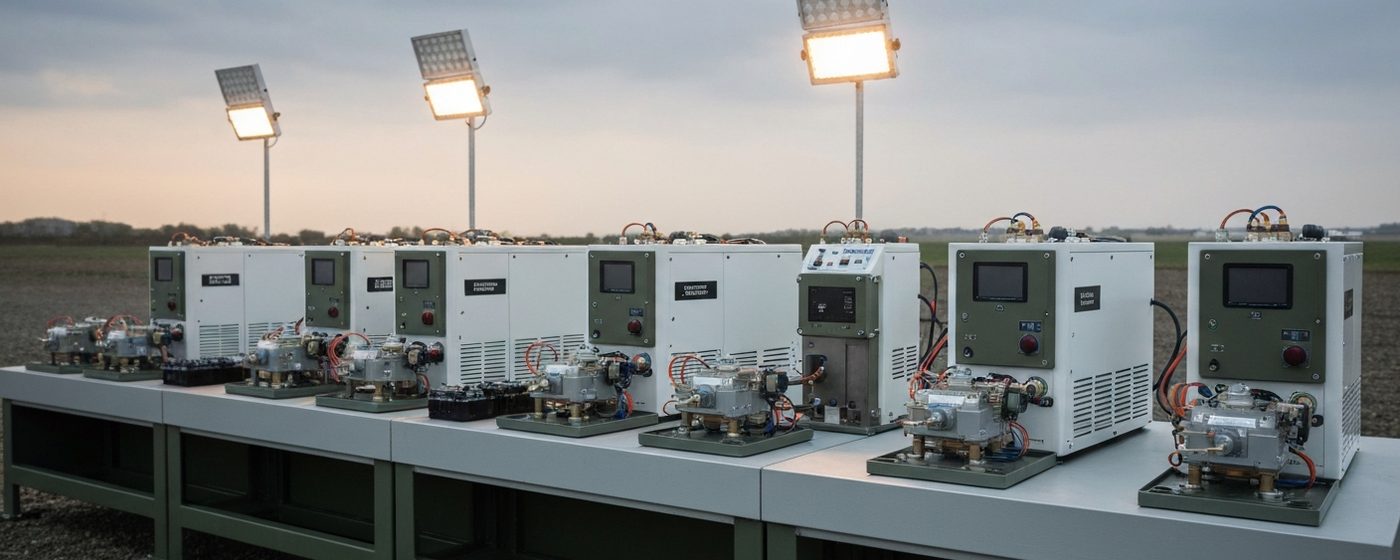
When every new weapons system drives the power meter higher
A modern battle tank needs fuel for its engine — that has always been the case. But a networked drone swarm that transmits data in real time, runs AI-assisted target acquisition, and simultaneously carries munitions needs something different: a reliable, compact, and decentralized power supply. This is precisely where a structural gap exists today within the U.S. armed forces, one that was publicly addressed at the Space and Missile Defense Symposium 2026.
Brigadier General Troy Denomy, head of the Program Executive Office Maneuver, summed up the problem bluntly: the military needs more energy — but not by purchasing additional generators. The message to industry was unambiguous: what is being sought are compact, field-ready energy solutions capable of keeping pace with the growing fleet of networked systems. At the same time, CENTCOM has stood up a multinational attack-drone unit encompassing unmanned systems operating above, on, and below the water's surface — an operational signal of just how broad the deployment scenarios have already become.
For investors tracking small caps in the defense and cleantech space, this represents a structural procurement signal. But the road from signal to signed contract is long and fraught with risk.
U.S. Defense Procurement Stages (Risk Level (1–4))
Why conventional generators do not solve the problem
Diesel generators are heavy, loud, maintenance-intensive, and produce a heat signature that poses a risk on the modern battlefield. They are suited for stationary bases, not for mobile or maritime drone operations. The military faces an equation familiar from the civilian industry: the more decentralized systems come online, the more untenable centralized power generation becomes.
The alternatives being sought fall broadly into three categories:
- Fuel cells (hydrogen-based or methanol-reformed): high energy density, low noise emissions, and well-scalable for medium loads.
- Solid-state batteries: higher energy density than lithium-ion cells, lower fire risk — but still in early production phases.
- Portable micro power plants based on turbine concepts or thermoelectric generators: useful where neither hydrogen nor sufficient charging infrastructure is available.
None of these approaches is technologically trivial, and none is yet field-ready at scale. That explains why the military is actively engaging with industry partners — and simultaneously why the market remains open.

IDIQ, OTA, and the mechanics of military procurement
Anyone who wants to put the U.S. military's procurement signal in context must understand two contract types that dominate the American defense sector:
IDIQ contracts (Indefinite Delivery, Indefinite Quantity) establish a framework with a maximum ceiling value — but they guarantee not a single unit of order volume. A company that qualifies for an IDIQ earns the right to submit bids for specific task orders. It has not yet booked any revenue. In articles and press releases, IDIQ awards are often promoted using the total ceiling value, which creates a distorted picture.
OTA contracts (Other Transaction Agreements) are more flexible and allow the military to work faster with non-traditional vendors — including start-ups without years of contracting history. They represent an important entry point for small caps, but they do require demonstrated technical maturity and prototype capability.
The civilian-sector analogy: a mid-sized software vendor listed on an EU framework agreement has not yet generated any project revenue — it has only earned the right to respond to tenders. The actual contracts come individually, are tied to budgets, and may never materialize.
| Procurement Type | What It Means for the Vendor | Risk for the Investor |
|---|---|---|
| RFI / Market Survey | Military gathers market intelligence, no contract awarded | High — no revenue signal |
| OTA Prototype Contract | Compensated prototype, no follow-on order guaranteed | Medium — limited revenue possible |
| IDIQ Framework Agreement | Qualification to bid on task orders, no minimum volume | Medium to high — book-to-bill ratio is decisive |
| Firm Task Order | Concrete contract with defined volume | Low — revenue can be recognized |
Drones above, on, and below the water — what CENTCOM's move signals
CENTCOM's establishment of a multinational attack-drone unit is operationally significant: it integrates unmanned systems across three domains — air, surface, and underwater. This places particular demands on power supply, because each domain operates under different physical constraints.
Unmanned underwater vehicles (UUVs) cannot use solar panels and face strict size and weight requirements. Fuel cells based on lithium-oxide compounds or oxygen-dependent systems are an active research field here. Maritime surface drones require systems that withstand saltwater, heat, and strong vibrations. Long-endurance loitering aerial drones favor lightweight energy sources with high energy density.
This technological fragmentation means there is no single "one size fits all" product. Different niche vendors could become relevant for different segments — making the investment picture more granular, but also broader.
What investors should soberly price in
The structural procurement signal from the U.S. military is real. The energy gap in networked weapons systems is not a short-term phenomenon but a multi-year trend receiving additional momentum from the proliferation of drone systems — accelerated by lessons learned from the war in Ukraine.
Nevertheless, several rules of discipline apply for small-cap investors:
- Press releases ≠ revenue: An announcement about a partnership with a government agency or participation in a military program is not a booked contract. Without a firm task order, cash runway remains the decisive metric.
- Check the cash runway: Many small caps in the energy technology space are still unprofitable. If the cash balance at the current burn rate covers only 12–18 months and a first defense contract is still 24 months away, a capital increase — and the resulting dilution for existing shareholders — becomes a real threat.
- Qualification risk: ITAR certification, the cybersecurity-related CMMC certification, and military field testing are hurdles that can cause even technologically capable companies to fail.
- Total loss of capital is a real scenario: If a small energy technology company cannot convert its OTA prototype contract into a follow-on order while simultaneously running out of capital, insolvency is not out of the question. Speculative small-cap status means total loss of capital is not a theoretical risk — it is a possible outcome.
Those monitoring this theme from a market perspective will find a structural long-term trend — but not a short-term share-price catalyst. In the defense industry, the timing between a procurement signal and the first bookable revenue is, by experience, longer than in any other sector. From a financial-education standpoint, the military energy theme is a strong example of how structural demand and near-term investment returns can be far apart.
This article is for educational purposes only and does not constitute investment advice.
Key Terms at a Glance
- IDIQ Contract
- "Indefinite Delivery, Indefinite Quantity" — a U.S. military framework agreement with a maximum ceiling value but no guaranteed minimum order. Vendors must first qualify before they may bid on specific task orders.
- OTA Contract
- "Other Transaction Agreement" — a flexible procurement instrument of the U.S. Department of Defense that allows non-traditional vendors (e.g., start-ups) to participate without having to meet all the requirements of standard acquisition regulations (FAR).
- Cash Runway
- The length of time a company can sustain operations with its current cash balance at its ongoing burn rate before needing new capital. Calculation: cash balance ÷ monthly burn rate = runway in months.
- Dilution
- When a company issues new shares (capital increase), the percentage ownership of existing shareholders decreases. For loss-making small caps, this is a frequently underestimated risk.
- Book-to-Bill
- The ratio of order intake to revenue (order intake ÷ revenue). A value above 1.0 signals order growth; a value below 1.0 indicates a shrinking order backlog.
- Solid-State Battery
- A battery technology that replaces the liquid electrolyte with a solid material. It offers potentially higher energy density and lower fire risk, but remains in the development or early production phase across many application areas.
- ITAR Certification
- "International Traffic in Arms Regulations" — U.S. export control regulations governing defense articles. Without ITAR authorization, a company may not supply defense-relevant products or technologies to the U.S. military or export them abroad.
- Loitering Munition
- Single-use drones capable of circling an area for an extended period before attacking a target. They impose special demands on energy density and endurance, and represent a growing procurement segment in the military drone market.
⚠️ Important notice: This article is for informational and educational purposes only. It does not constitute investment advice, a recommendation, or a solicitation to buy or sell any security. Investments in small-cap exploration and mining companies carry a high risk, including the potential total loss of capital. Before making any investment decision, consult a registered financial advisor and conduct your own analysis. Aktienatlas-Redaktion is not responsible for decisions taken based on the content published here.
Educational content only, not investment advice. Small caps are highly speculative and total loss is possible.