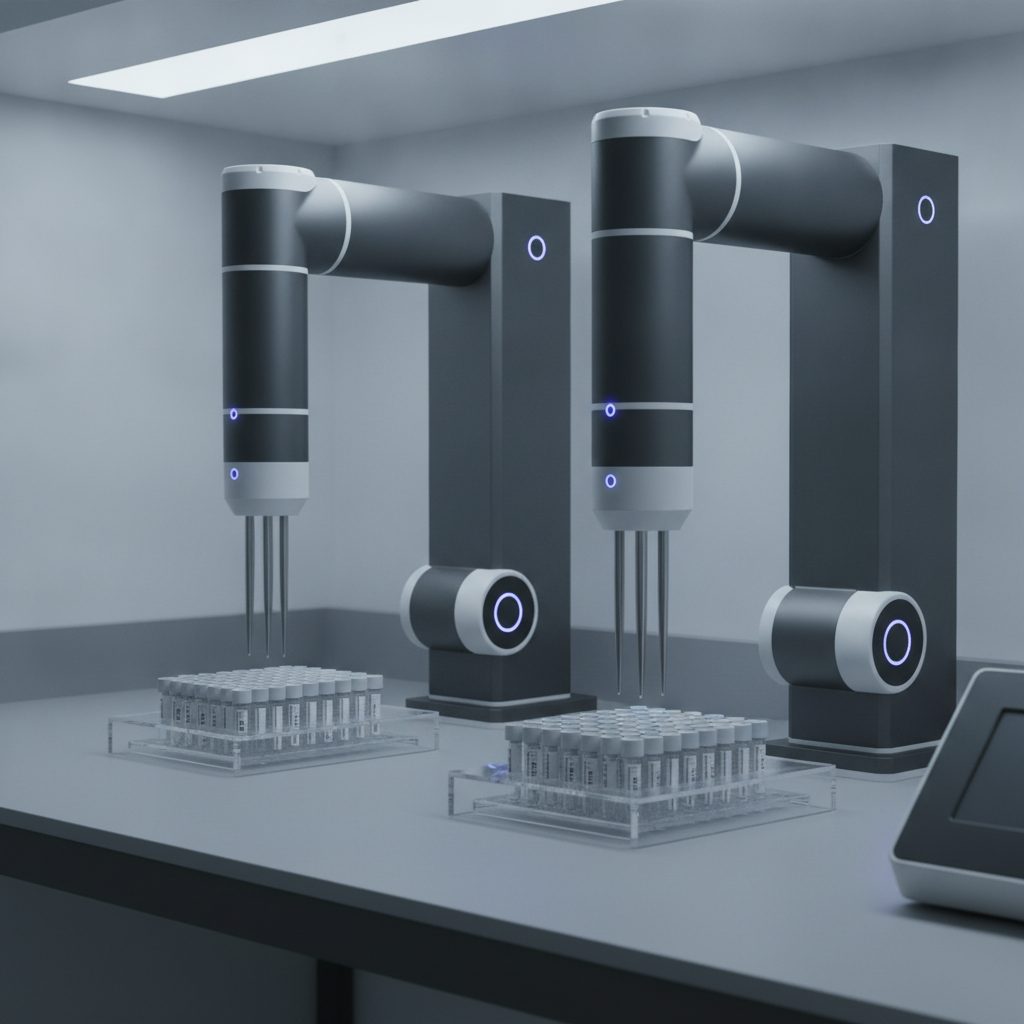
 Symbolbild · KI-generiert
Make-or-Buy in the Lab: AI Orchestration and Its Impact on Biotech Investors

When the Lab Becomes a Platform
In the manufacture of advanced therapeutics — from cell and gene therapies to biopharmaceutical drug substances — a new industrial pattern is emerging: the laboratory is no longer merely a place for experimentation, but is evolving into a networked platform in which AI systems coordinate process steps, evaluate quality data in real time, and automatically adjust production parameters. Specialists refer to this as laboratory orchestration — the software-driven integration of instruments, data streams, and decision logic within a manufacturing environment.
For investors focused on biotech small caps, this is not an abstract technology question. It reflects a classic strategic business decision that determines capital allocation, dilution risk, and the path to profitability: Does a company build this platform capability in-house, purchase an existing solution, or enter a licensing or cooperation agreement? This make-or-buy-or-license question is well known in capital-intensive sectors. In the biotech context, however, it carries particular urgency, because each investment path places a different burden on the cash runway.
Make-or-Buy: Comparing the Three Strategic Paths (Risk Score (1–5))
Lab Automation in Market Context: Why Now?
Several parallel developments explain why AI-driven laboratory orchestration is reaching industrial maturity right now. First, the demands placed on novel therapeutic modalities have risen sharply: personalized treatments — such as autologous CAR-T cell therapies — require strictly controlled, reproducible manufacturing processes in which tiny parameter variations can compromise product quality. Human oversight alone can scarcely scale economically in this environment.
Second, the costs of sensors, cloud infrastructure, and interfaces (APIs) between laboratory instruments have fallen significantly in recent years, making the integration of heterogeneous devices into a unified data system affordable for mid-sized facilities for the first time. Third, regulators such as the FDA and EMA have signaled — through concepts such as Continuous Manufacturing and digital process monitoring — that data-driven quality control is not merely accepted but increasingly expected.
For small-cap biotechs without their own manufacturing capacity, this creates pressure: any company seeking to remain competitive as a Contract Development and Manufacturing Organization (CDMO) or as an independent manufacturer will need to be able to explain how its production line is digitally controlled and documented.
The Make-or-Buy Mechanics: Three Paths, Three Risk Profiles
When a small biotech company faces the question of how to integrate laboratory orchestration into its manufacturing operations, three primary paths are available — each with its own financing profile.
1. Make (In-house Development): The company builds its own AI platform for laboratory processes. The advantage: proprietary technology can create a lasting competitive edge and thus a higher enterprise value. The disadvantage: development ties up substantial capital over an extended period — capital that, for a Phase II biotech, would also be needed for clinical trials. The burn rate rises, the cash runway shortens, and the next capital increase (share issuance) draws closer — bringing with it the associated dilution risk for existing shareholders.
2. Buy (Acquisition or Licensing of an Existing Solution): Here the company acquires a ready-made platform or pays for access to one. The advantage is speed: integration proceeds far faster than in-house development. The disadvantage: ongoing licensing fees permanently weigh on results, and the company becomes dependent on an external vendor whose roadmap and terms may change.
3. License-Out / Cooperation Model: Some companies attempt to become platforms themselves — they develop an orchestration solution and license it to third parties, generating revenues that cross-finance their clinical arm. This model resembles the dual strategy used by some gene therapy firms that simultaneously leverage their vector technology internally and commercialize it externally. The approach can reduce dependence on equity financing, but carries the risk of loss of focus: competing in two markets at once demands strong management bandwidth.
| Strategy | Capital Burden | Dilution Risk | Time Required |
|---|---|---|---|
| In-house Development (Make) | High (upfront + ongoing) | Elevated (more funding rounds) | Long (2–5 years) |
| License Purchase (Buy) | Medium (ongoing fees) | Moderate | Short (months) |
| Cooperation Model | High (initially) | Variable | Medium |
What Investors Can Read from Capital Allocation
For investors analyzing biotech small caps, a company's make-or-buy decision provides important information — not about the quality of the technology, but about management's strategic priorities.
An analogy from the software sector makes this tangible: in the early years of the cloud era, many mid-sized software companies faced the question of whether to operate their own data centers or rely on major cloud providers. Companies that opted early for licensing were able to develop their core product faster — while those that built their own infrastructure sometimes created defensible competitive advantages, but required significantly more time and capital. In the biotech sector, a similar selection process is underway: companies investing early in platform capital must be able to explain how that investment accelerates clinical endpoints or regulatory milestones — otherwise the use of resources looks like a distraction from the core mission.
Specifically, investors should watch for the following signals in company reports and quarterly communications:
- Ratio of R&D expenditure to operating expenses: If the share of technology development is growing relative to clinical research, this indicates a platform-first prioritization.
- Cash runway: If the cash cushion (cash balance divided by monthly burn rate) covers less than twelve months, dilution risk is elevated — regardless of whether the capital is flowing into an AI platform or a clinical trial.
- Milestone structure of cooperation agreements: Are these binding call-offs or letters of intent without firm payment obligations? A partnership that does not guarantee secured revenues does not improve the runway.
A further risk factor is technological dependency: if a small-cap biotech builds its entire laboratory automation on the platform of a single vendor, it creates a concentration that can lead to significant operational disruptions if that vendor changes its contract terms or becomes insolvent.
Understanding Platform Logic, Assessing Risk
Whether a biotech company builds, buys, or licenses its laboratory orchestration is often difficult for outsiders to discern — it is embedded in R&D budgets, in the structure of cooperation agreements, and in the footnotes of quarterly reports. Nevertheless, it has direct consequences for the timing and scale of future capital increases.
Investors active in this space would do well to distinguish between platform narratives and clinical progress. An AI-driven manufacturing platform is not a substitute for Phase III trial data. It can accelerate the manufacturing process, reduce failure rates, and fulfill regulatory requirements more efficiently — but it eliminates neither approval risk nor financing risk.
As in many areas of speculative technology investing, the narrative around platform technology can drive valuations before real revenues or clinical results are available. This is not a new dynamic — it has already appeared with mRNA platforms, diagnostic AI systems, and CDMO infrastructure projects. When it comes to total loss of capital risk, it makes no difference whether the money flowed into a failed trial arm or into a platform that was never commercially exploited.
This article is intended solely for financial education and does not constitute investment advice.
Key Terms Explained
- Laboratory Orchestration
- The software-driven, often AI-controlled integration of laboratory instruments, data streams, and process steps into a unified manufacturing system. The goal is to reduce manual interventions and optimize production parameters in real time.
- Make-or-Buy Decision
- The strategic choice of whether a company builds a required capability in-house (make), purchases or licenses it externally (buy), or obtains it through a cooperation agreement. Each option carries different capital and time implications.
- Cash Runway
- The length of time a company can sustain operations with its current cash balance and monthly expenditure rate (burn rate) before new capital is required. Calculation: cash balance ÷ monthly burn rate.
- Dilution
- When a company issues new shares — for example, to carry out a capital increase — the percentage ownership of existing shareholders in the total company decreases. The more frequent and larger such rounds are, the greater the dilution.
- Burn Rate
- The monthly net cash outflow of a company that generates little or no revenue. A rising burn rate shortens the cash runway and increases pressure to raise additional financing.
- CDMO (Contract Development and Manufacturing Organization)
- A contract service provider that handles the development and manufacture of drug substances or therapeutics on behalf of pharmaceutical companies. For small-cap biotechs without their own production facilities, this is often the preferred alternative to in-house manufacturing.
- Platform Capital vs. Clinical Capital
- The distinction between investments in technology platforms (e.g., laboratory automation, AI systems) and investments in the clinical development pathway (trials, regulatory processes). Both objectives compete for the same pool of resources within a small-cap company's budget.
⚠️ Important notice: This article is for informational and educational purposes only. It does not constitute investment advice, a recommendation, or a solicitation to buy or sell any security. Investments in small-cap exploration and mining companies carry a high risk, including the potential total loss of capital. Before making any investment decision, consult a registered financial advisor and conduct your own analysis. Aktienatlas-Redaktion is not responsible for decisions taken based on the content published here.
Educational content only, not investment advice. Small caps are highly speculative and total loss is possible.