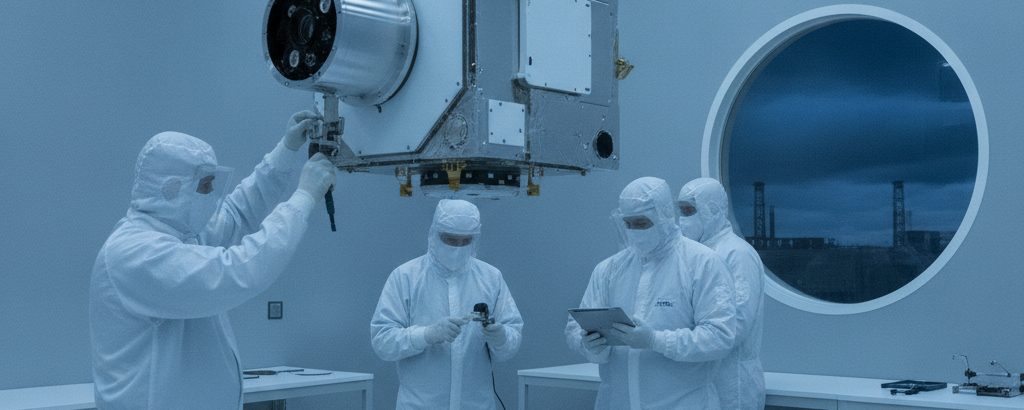
 Symbolbild · KI-generiert
Laser Communication in Orbit: What Demonstration Contracts Mean for Space Small Caps
Light as a Data Cable in Space — A New Chapter in Military Communications
In modern warfare, communications are not a secondary concern — they are the critical bottleneck. Whoever can transmit data faster, more securely, and with greater protection against interception holds a strategic advantage. That is precisely where optical satellite communications come in: instead of radio waves, focused laser beams are used to send data packets between satellites in orbit. The technology is considered significantly harder to jam or intercept than conventional radio links — a property that makes it especially attractive for military applications.
In this context, the young U.S. space company K2 Space has received a contract worth $22.9 million from the U.S. Space Force. Two K2 Space satellites are to carry optical terminals that connect military systems in orbit. At first glance this sounds like a breakthrough — but investors are well served by a sober look behind the headline.
Demonstration Contracts: Government Risk Capital With Conditions
What the U.S. Space Force is awarding here is not a conventional procurement order but a so-called demonstration contract — a development and testing agreement. The distinction is fundamental for investors and is frequently blurred in media coverage.
Under a firm delivery order, the government purchases an already proven system in a defined quantity at a fixed price. That is foreseeable, recurring revenue. A demonstration contract, by contrast, funds proof that a technology works in principle — under real-world conditions, in this case in orbit. The outcome is open: the technology may succeed, fail, or require further adjustment.
For a small space company like K2 Space, such a contract nevertheless serves several important functions:
- Extending the cash runway: $22.9 million flows into the company without requiring new shares to be issued. That reduces dilution pressure in the short term.
- Technology qualification: A successfully completed demonstration test is a form of government seal of approval — an important signal for follow-on contracts and future competitive bids.
- Visibility in the procurement system: A company that is already listed in the U.S. Space Force system and has successfully executed a contract holds a structural advantage over newcomers in future award processes.

How Markets React to Government Development Contracts — and Why
Small space and defense companies with little or no meaningful revenue are not valued by the market using traditional metrics such as price-to-earnings ratios. Instead, investors orient themselves around so-called milestones: contract wins, technology demonstrations, partnership announcements, and key personnel decisions drive valuations — regardless of whether the company is profitable.
This valuation logic has its own dynamic. A contract win like K2 Space's signals to capital markets that a creditworthy client — in this case the U.S. military — considered the technology mature enough to invest public funds. In the eyes of some investors, this reduces perceived technological uncertainty. The result is frequently outsized share price reactions among small caps, because these companies trade with lower liquidity and even small order volumes can move the price sharply.
A comparison from recent space history illustrates the pattern: when several small satellite operators won their first contracts with NASA or the U.S. Department of Defense in the early 2020s, their shares sometimes rose by double digits in a single trading session — before a single kilogram of hardware had been built. In the short term that can look attractive; over the medium to long term, however, actual contract execution determines whether the valuation holds or corrects.
An analogous pattern emerged in the early days of the drone industry: companies went through similar phases of government-funded demonstration projects before scalable procurement contracts followed. Not every candidate made the transition — and that is precisely where the risk for investors lies.
| Contract Type | Characteristic | Revenue Implications |
|---|---|---|
| Demonstration Contract | Technology proof-of-concept; outcome open | One-time, non-recurring |
| Framework Agreement (IDIQ) | Maximum order volume defined; no firm commitment | Potential, but no guaranteed revenue |
| Firm Delivery Order | Defined quantity, schedule, and price | Directly revenue-generating; predictable |
Concentrated Counterparty Risk: When One Client Means Everything
Demonstration contracts solve an immediate problem — the cash runway — but can create a medium-term one: dependence on a single government client. If K2 Space derives the majority of its revenue from a single contract with the U.S. Space Force, it faces concentrated counterparty risk. Budget cuts, shifting political priorities, or a straightforward agency decision to develop the technology in-house or award it to a different vendor can abruptly halt revenue.
This pattern is structurally familiar in the defense and space segment. Smaller suppliers and technology developers find themselves in an asymmetric negotiating position relative to government clients: the customer is large, the vendor is small — and the switching costs typically fall on the vendor, not the client. Adding to this, U.S. defense contracts are subject to annual appropriations risk: congressional delays in passing the defense budget (so-called Continuing Resolution periods) can interrupt payment flows even when a contract is technically active.
Investors in defense and space small caps are therefore advised to scrutinize the revenue structure carefully: what share of total revenue comes from a single client? The book-to-bill ratio — order intake divided by recognized revenue — provides an initial indication of whether a company is booking only a one-off win or building a sustainable pipeline.
What Remains Once the Euphoria Fades
With this contract, K2 Space has reached an important milestone: government validation of a technology considered strategically relevant in military communications. Optical satellite links — also known as Laser Inter-Satellite Links (LISLs) — are expected to remain a growth segment over the medium term, because modern Low Earth Orbit (LEO) constellations require precisely this type of backbone communication.
Even so, one thing holds true: a single demonstration contract does not turn a young space small cap into a profitable business. The technological, operational, and financial risks remain substantial. Anyone investing in such companies must accept that a failed demonstration test, a further capital increase (share issuance), or the loss of the sole government client can lead to a total loss of capital. That is not the exception in this segment — it is the statistical reality for most early-stage space small caps.
The sober framework therefore remains: demonstration contracts are a necessary, but not sufficient, condition for commercial success. They extend a company's lifespan, buying time for further development — and that in itself is already valuable. Whether a viable business model ultimately emerges is decided only in the years that follow, when demonstrations either convert into real production orders — or do not.
Key Terms for Beginners
- Demonstration Contract
- A government contract to test a technology under real-world conditions. The outcome is open; it is not a production or delivery order.
- Cash Runway
- The length of time a company can sustain operations with its existing liquid assets before requiring new capital. Calculated as: cash balance ÷ monthly burn rate (cash outflow).
- Dilution
- When a company issues new shares to raise capital, the ownership stake of existing shareholders decreases. Every new funding round can reduce the value of existing shares.
- Book-to-Bill Ratio
- Order intake divided by recognized revenue over a given period. A value above 1 indicates that more orders are coming in than are being fulfilled — a positive signal for future growth.
- Counterparty Risk
- The risk that a contracting party (here: the government client) fails to meet its obligations or does not renew the contract. When a company depends on a single client, this risk is especially concentrated.
- Laser Inter-Satellite Link (LISL)
- An optical communications link between satellites using laser beams. Considered more resistant to interception and more bandwidth-efficient than conventional radio links.
- Low Earth Orbit (LEO)
- An orbit at altitudes typically between 200 and 2,000 kilometers above Earth. LEO satellites enable low signal latency but generally require larger constellations for global coverage.
⚠️ Important notice: This article is for informational and educational purposes only. It does not constitute investment advice, a recommendation, or a solicitation to buy or sell any security. Investments in small-cap exploration and mining companies carry a high risk, including the potential total loss of capital. Before making any investment decision, consult a registered financial advisor and conduct your own analysis. Aktienatlas-Redaktion is not responsible for decisions taken based on the content published here.
Educational content only, not investment advice. Small caps are highly speculative and total loss is possible.