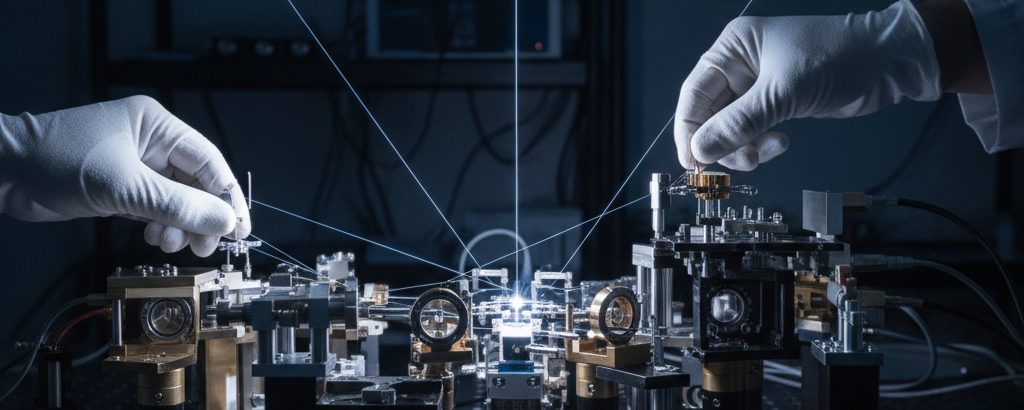
 Symbolbild · KI-generiert
IonQ and Nvidia: When Qubit Milestones Meet Stock Prices
Thirty Qubits, One Partnership — and a Stock in the Red
Anyone following quantum computing stocks knows the pattern: a company announces a technical breakthrough, the stock jumps — and yet the share price is still well below where it was a year ago. That is exactly what played out this week with IonQ (Nasdaq: IONQ). The company announced that it had successfully entangled 30 error-protected qubits in a shared quantum state. At the same time, a research partnership with Nvidia was confirmed, which includes the installation of an IonQ quantum computer at an Nvidia research center. The stock moved higher in response — but remains roughly 43% below its level from a year ago.
This apparent contradiction is no accident. It is the structural core problem of the entire quantum computing segment: technological milestones and commercial maturity operate on different timelines. Understanding this changes how you evaluate news from the sector.
Year-to-Date Performance IonQ (IONQ) vs. Event (%)
From Physics to Production Readiness: The Long Road to Revenue
Quantum computers operate on fundamentally different principles than classical computers. While classical bits are either 0 or 1, qubits can occupy both states simultaneously — a principle known as superposition. When multiple qubits are combined in a so-called entangled state, a collective computational capacity emerges that is theoretically far superior to classical systems for certain problems — such as optimization tasks in chemistry, logistics, or cryptography.
The central technical challenge: qubits are extremely error-prone. Any external disturbance — heat, magnetic fields, vibrations — can destroy the quantum state, a phenomenon known as decoherence. Error correction — securing these fragile states — is considered the defining engineering challenge of the decade. IonQ's announcement that it can maintain 30 so-called logical qubits — that is, error-protected qubits — in an entangled state represents a measurable step forward in this context.
But between a laboratory result and a billable product lie several stages: reproducibility, scalability, software integration, certification, and ultimately connecting with paying customers. It is comparable to the semiconductor industry of the 1960s — the transistor had been invented, but it would take decades before mass production of microprocessors became a reality.

What the Nvidia Partnership Actually Signals — and What It Does Not
The research cooperation with Nvidia is strategically significant — but investors should read carefully what was actually agreed upon: this is a research partnership, not a supply contract or a revenue agreement. The planned installation of an IonQ device at an Nvidia research center is a validation signal — Nvidia, one of the most valuable companies in the world, is testing the technology and considers it relevant for research purposes. For a young quantum computing company, that is a meaningful reference point.
But a partnership is not an order intake. In the defense and technology industries, a clear distinction is drawn between a letter of intent, a framework agreement with a maximum contract volume, and a firm call-off with a specific delivery date and invoicing. A research partnership sits well below a firm contract in this hierarchy. Billable revenues only arise when a product is actually delivered and invoiced.
Historical parallels from other deep-technology fields are instructive: when early fuel cell technologies launched pilot projects with automakers in the 2000s, the stocks of the start-ups involved were regularly driven higher — even though series production was still many years away. Some of those companies did not survive the wait.
Valuation Without Profits: The Metrics Trap in the Quantum Segment
IonQ — like most quantum computing companies — is not yet profitable. The company finances research, development, and operations from existing capital reserves and occasional capital increases (share issuances). In such an environment, traditional metrics like the price-to-earnings ratio (P/E) offer little insight for investors. Instead, other metrics take center stage:
| Metric | What It Measures |
|---|---|
| Cash Runway | Cash on hand ÷ monthly burn rate → months until the next funding round is needed |
| Revenue Growth (YoY) | Whether early commercial contracts are growing — no profit, but a directional indicator |
| Price-to-Sales Ratio (P/S) | Market capitalization relative to achieved revenue — reveals the expectation premium |
| Dilution Risk | Share of new shares issued via capital increases — reduces the value of existing holdings |
The cash runway carries particular weight: as long as a quantum computing company cannot generate sufficient revenues, it burns capital. When liquidity runs low, two paths remain — a new capital increase that dilutes existing shareholders, or in the worst case, a shutdown of operations. Both are real scenarios that the market attempts to price in — often incompletely and with high volatility.
Added to this is the valuation logic for growth stocks without profits: the current price of such a company discounts future cash flows that lie far in the future. This makes these stocks particularly sensitive to interest rates — when rates rise, the present value of those distant earnings falls, and the stock declines even if nothing has changed technologically. This mechanism partly explains why IonQ remains under pressure year-over-year despite positive announcements.
What the IonQ Moment Means for the Quantum Segment as a Whole
The IonQ case is representative of a class of deep-technology companies where technical progress and stock market valuations often remain decoupled. This is not a market failure — it reflects a fundamental uncertainty: no one knows with confidence when quantum computing will make the leap to broad commercial relevance. Estimates from research institutes and consulting firms range from the end of this decade to well into the 2030s — a range that is barely manageable for valuation models.
The research partnership with Nvidia sends an important signal: major corporations with substantial technological expertise take quantum computing seriously enough to commit resources. Something similar was observed in the early phase of artificial intelligence, when Google, Microsoft, and IBM formed initial research alliances with small AI labs — years before those technologies became mainstream. Not all pioneers of that wave survived, but the technology itself prevailed.
For investors watching the quantum segment, this points to an analytical task: less about evaluating any single press release, and more about systematically tracking the distance between technological maturity and a billable business model — and honestly assessing one's own risk tolerance.
Terms to Know When Reading Quantum Computing News
- Logical Qubit
- An error-protected qubit secured against disturbances through the redundancy of multiple physical qubits. Only logical qubits enable reliable computations at larger scale.
- Quantum Entanglement
- A quantum mechanical state in which two or more qubits are correlated such that the state of one instantly influences the state of the other — regardless of physical distance.
- Decoherence
- The loss of a qubit's quantum state through interaction with its environment. Decoherence is the central technical problem that makes error correction necessary.
- Cash Runway
- The period of time a company can sustain operations with its current liquidity reserves at a constant rate of expenditure before a new funding round becomes necessary. Calculation: cash on hand ÷ monthly burn rate.
- Dilution
- The reduction of existing shareholders' percentage ownership in a company through the issuance of new shares — for example, as part of a capital increase to finance ongoing losses.
- Research Partnership vs. Order Intake
- A research partnership involves the joint development or use of technology, but does not generate immediately billable revenues. An order intake represents a binding contract with a defined scope of delivery and payment obligation.
- Price-to-Sales Ratio (P/S)
- Market capitalization divided by annual revenue achieved. For loss-making growth companies, the P/S ratio serves as a proxy for making expectation premiums relative to current operating performance visible.
⚠️ Important notice: This article is for informational and educational purposes only. It does not constitute investment advice, a recommendation, or a solicitation to buy or sell any security. Investments in small-cap exploration and mining companies carry a high risk, including the potential total loss of capital. Before making any investment decision, consult a registered financial advisor and conduct your own analysis. Aktienatlas-Redaktion is not responsible for decisions taken based on the content published here.
Educational content only, not investment advice. Small caps are highly speculative and total loss is possible.