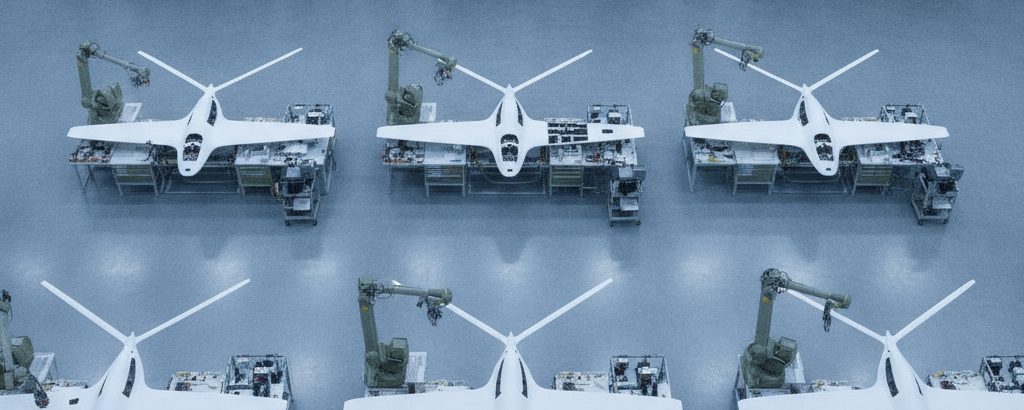
 Symbolbild · KI-generiert
Import Barriers on Drones: How Trade Policy Is Splitting Supply Chains
When Trade Policy Becomes a Technology Barrier
Throughout the history of trade barriers, tariffs have typically protected traditional industries: steel, textiles, agriculture. What is unfolding today in the autonomous systems space follows a different logic entirely. The United States is erecting targeted import barriers against Chinese drones and ground robots — not primarily out of economic protectionism, but out of national security conviction. The concern: devices made by Chinese manufacturers could transmit data to state authorities or leave vulnerabilities embedded in critical infrastructure.
For investors interested in small caps in the defense and robotics space, this development is not an abstract geopolitical backdrop — it concretely determines who wins which contracts, what margins are realistic, and which supply chains remain viable over the long term. Understanding this dynamic is a prerequisite before examining any individual company.
Two Markets, Two Dynamics: The Core Divergence
The key difference from classical trade policy lies in the asymmetry of manufacturing capacity. China has built up a scale of production over many years that Western competitors can rarely match across the board — particularly in consumer drones and industrial systems. A U.S. import ban hits Chinese manufacturers hard in the American market, but does not exclude them from the rest of the world.
This creates a market split into two parallel arenas:
- U.S. domestic market: Chinese suppliers are pushed out. Western suppliers and system integrators gain structurally more room — provided they can meet quality, delivery volume, and certification requirements.
- Third-party markets (e.g., the Middle East, parts of Asia, Latin America): Here, China can continue to exploit its cost advantages. Western small caps selling globally face a Chinese competitor that is additionally motivated to expand more aggressively, having been shut out of the U.S. market.
How Trade Restrictions Reshape the Value Chain
Import bans do not take effect overnight. The actual restructuring of a supply chain takes years and unfolds in phases that investors should understand:
Phase 1 — Substitution Pressure: Once a supplier is excluded from a market, a gap appears. For components — sensors, propulsion systems, communication modules — system integrators quickly seek alternative suppliers. Small, specialized suppliers may initially attract attention here, but a first contact is not a contract, and a pilot project is not yet a secured supply relationship.
Phase 2 — Qualification Bottlenecks: U.S. defense contracts often require ITAR compliance (International Traffic in Arms Regulations) or other security certifications. A small cap that could technically deliver may need 12 to 24 months to clear these formal hurdles. During this time, it burns capital without corresponding revenue — cash runway (cash on hand divided by monthly burn rate) becomes the critical metric to watch.
Phase 3 — Consolidation: Once the new supply chains have stabilized, platform providers begin acquiring smaller specialists or concluding long-term framework agreements. Only at this stage does it become clear which small caps have become genuine long-term suppliers and which merely benefited from short-term substitution demand.
An analogous pattern was visible in the semiconductor industry following the first U.S. export restrictions against a major Chinese telecom equipment maker: initially, a number of small chip developers benefited from substitution demand, but over the long term market share consolidated among a handful of high-performing suppliers.
What CENTCOM Drone Procurement and Gulf State Contracts Reveal
The geopolitical dimension extends beyond the Sino-American conflict. In the Middle East — one of the most active procurement markets for autonomous systems — a new balance of power is taking shape. CENTCOM, the U.S. Central Command, is expanding its drone capabilities; at the same time, Gulf states are negotiating with a wide range of Western and non-Western suppliers. Tanker operations in the Gulf of Oman, the protection of energy infrastructure, and surveillance of strategically vital maritime chokepoints are driving regional demand.
For Western small caps, potential export markets are emerging here — but so are regulatory risks. Defense exports to the region are subject to national licensing procedures that can change rapidly. A company that holds an export license today may face a licensing freeze tomorrow. Such licensing risks often appear only as a footnote in annual reports, yet they can threaten a significant portion of a company's revenue guidance.
| Factor | Opportunity Signal for Western Small Caps | Risk Signal |
|---|---|---|
| U.S. import ban on Chinese drones | Substitution demand in the domestic market | Lengthy qualification process, high capital consumption |
| Chinese export offensive into third-party markets | Little direct benefit | Competitive pressure in global sales markets |
| CENTCOM / NATO drone procurement | Long-term framework agreements possible | No guaranteed order intake without firm orders |
| Middle East export markets | High demand, well-funded buyers | Export licensing risk, political instability |
Structural Lessons for Investors in This Segment
Geopolitically motivated trade barriers create real market shifts — but the beneficiaries are rarely obvious from the outset. Investors monitoring small caps in the autonomous systems space should prioritize the following questions:
- Revenue structure: What percentage of revenue comes from U.S. government contracts, how much from the private sector, and how much from international markets? This breakdown determines on which side of the geopolitical divide the company sits.
- Cash runway: How many months can the company operate without raising new capital? During the qualification phase for new supply relationships, costs arise before revenue flows in. Small caps without sufficient liquidity reserves risk a dilutive capital increase on unfavorable terms — or, in the worst case, insolvency.
- Framework agreement vs. firm order: A framework agreement (Indefinite Delivery / Indefinite Quantity, IDIQ) sets a ceiling value but contains no guaranteed order intake. Only a firm order or a specific purchase order establishes bookable revenue.
- Technological differentiation: Can the company deliver something that Chinese manufacturers — despite their cost strength — cannot offer, such as specific security certifications, proprietary software, or distinct military performance characteristics?
The risk of a total loss of capital remains real in this segment. Small caps with no revenue of their own, waiting for a large government contract, can run into financial distress before that contract is formally awarded. Geopolitical tailwinds are no substitute for sound fundamentals.
Key Terms for Getting Started with Analysis
- Import Barrier / Import Ban
- A government measure that restricts or prohibits the import of certain goods from defined countries — may be based on tariffs, licensing restrictions, or national security legislation.
- Cash Runway
- A key metric: cash on hand divided by monthly net cash outflows (burn rate). Indicates how many months a company can operate without raising new capital. Below six months is generally considered critical.
- Framework Agreement (IDIQ)
- A contract type widely used in U.S. defense procurement (Indefinite Delivery / Indefinite Quantity): sets a maximum volume and terms, but contains no guarantee of actual order intake.
- Firm Order
- A specific, binding purchase order placed within a framework agreement. Only this constitutes bookable revenue that can be recognized on the income statement.
- Capital Increase (Secondary Offering) and Dilution
- When a company issues new shares to raise capital, existing shareholders' ownership stake in the company is reduced. For loss-making small caps, this is common and can place significant downward pressure on the share price.
- ITAR Compliance
- International Traffic in Arms Regulations: a U.S. regulatory framework controlling the export and transfer of defense articles and technologies. Suppliers for U.S. defense contracts are generally required to be ITAR-certified — a time-consuming and cost-intensive process.
- Book-to-Bill Ratio
- The ratio of order intake to revenue in a given quarter. A value above 1.0 signals that more orders are coming in than are being invoiced — a positive indicator for future growth; a value below 1.0 suggests a shrinking order backlog.
⚠️ Important notice: This article is for informational and educational purposes only. It does not constitute investment advice, a recommendation, or a solicitation to buy or sell any security. Investments in small-cap exploration and mining companies carry a high risk, including the potential total loss of capital. Before making any investment decision, consult a registered financial advisor and conduct your own analysis. Aktienatlas-Redaktion is not responsible for decisions taken based on the content published here.
Educational content only, not investment advice. Small caps are highly speculative and total loss is possible.