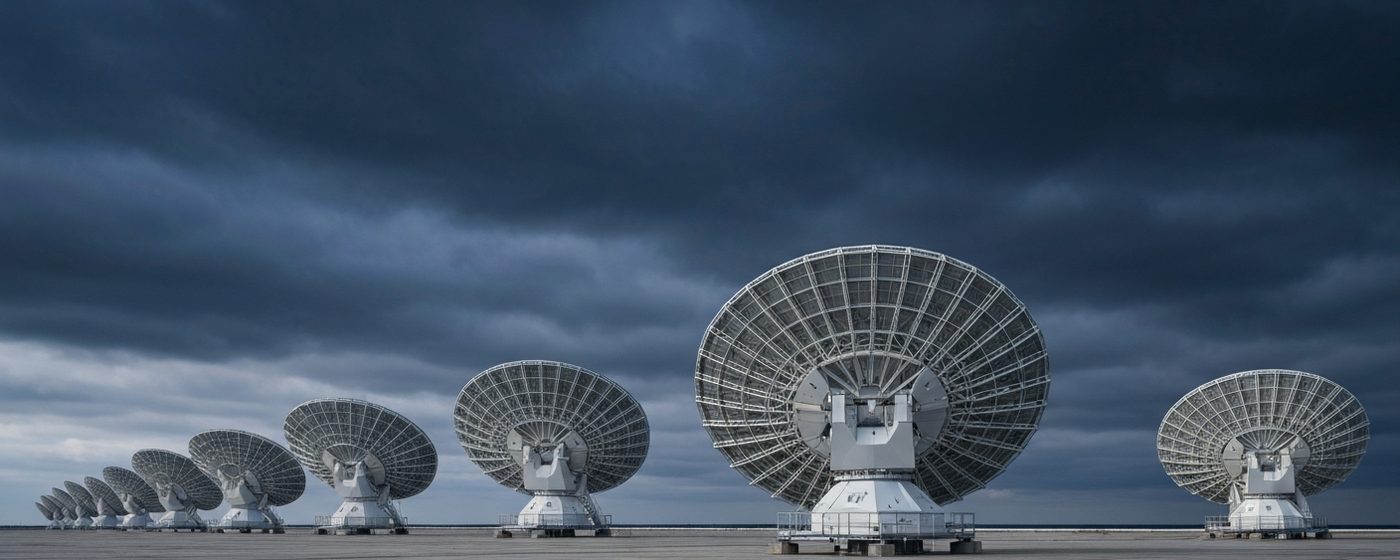
 Symbolbild · KI-generiert
Hughes Bankruptcy: What LEO Disruption Means for Satellite Investors
When an Orbital Advantage Becomes a Competitive Liability
For decades, geostationary orbit — GEO, roughly 36,000 kilometers above the equator — was considered the gold standard for satellite broadband. A single satellite positioned there could serve nearly an entire continent. EchoStar's Hughes division built a multi-billion-dollar business on exactly this model, providing internet access to millions of rural U.S. households where no fiber cable could reach.
Then came the LEO constellations. SpaceX's Starlink, operating in low Earth orbits between 340 and 1,200 kilometers, rewrote the rules: lower latency, higher speeds, falling terminal prices. The result was a gradual — then accelerating — erosion of GEO providers' customer base. Hughes Network Systems, EchoStar's satellite broadband subsidiary, has now filed for bankruptcy in the United States — an event that points well beyond a single corporate case.
For investors in space and telecom small caps, this case is a masterclass in technological disruption. It illustrates how quickly a seemingly stable business model can come under pressure — and what structural questions this raises for the industry as a whole.
GEO vs. LEO: Latency as a Competitive Factor (ms)
GEO vs. LEO: Physics as a Market Driver
To understand the Hughes bankruptcy, one must grasp the fundamental technical differences between GEO and LEO satellites — because they are the true driver of competitive dynamics.
A GEO satellite appears to hover motionless over a fixed point on Earth. This makes it easy to receive: a fixed-mount antenna is all that's needed. The drawback is the enormous distance of 36,000 kilometers: the signal requires approximately 600 milliseconds for a round-trip — a latency that is unacceptable for real-time applications such as video calls or online gaming.
LEO satellites orbit at altitudes of just a few hundred kilometers. Latency falls to 20–40 milliseconds — comparable to a good cable internet connection. The downside: a single satellite covers only a small area and is visible to any fixed point for just a few minutes. This is why hundreds or thousands of satellites are needed, taking turns in a coordinated constellation. Starlink already operates more than 6,000 such satellites — and SpaceX plans to launch even more capable versions using the next generation of its Starship launch vehicle.
The key market-dynamics principle: as launch costs plummeted thanks to reusable rockets, the capital-intensive LEO constellation model became economically viable. What was previously the exclusive domain of nation-states became a commercial competition — and that competition hit GEO operators like Hughes with full force.

The Mechanics of Disruption: Why Incumbents React So Late
A classic pattern from innovation research — familiar from Clayton Christensen's concept of "disruptive innovation" — plays out here almost by the book: the challenger initially enters a segment that the incumbent is unwilling or unable to defend. Starlink initially targeted niches (ships, aircraft, remote locations) that Hughes served only marginally anyway. But through rapid price declines and economies of scale, the challenger moved into the core market.
GEO operators are caught in a structural trap: a satellite costs several hundred million dollars and is designed to last 15 to 20 years. Depreciation cycles are long, fixed costs are high. Once a satellite has been placed in GEO orbit, it must be refinanced over its entire operational life — regardless of whether the market has since moved in a different direction. This capital lock-in makes rapid strategic pivots nearly impossible.
Compounding this is the public funding problem: Hughes benefited for years from U.S. federal broadband programs (FCC subsidies) for rural connectivity. When those programs were opened to LEO providers as well, a significant layer of competitive protection fell away. This is another pattern investors should recognize: regulatory moats can erode faster than balance sheets can absorb.
In parallel with the Hughes case, the market is sending new signals: reports indicate that Meta Platforms Inc. is exploring potential entry points into satellite communications. Even though such early-stage deliberations remain far from a concrete project — expressions of interest and preliminary talks are not proven business models — they signal that capital is increasingly flowing into the LEO segment and adjacent infrastructure.
| Characteristic | GEO Satellite | LEO Constellation |
|---|---|---|
| Altitude above Earth | ~36,000 km | 340–1,200 km |
| Latency (round-trip) | ~600 ms | 20–40 ms |
| Satellites per system | 1–3 | Hundreds to thousands |
| Investment cycles | 15–20 years | 3–5 years (rolling) |
| Launch-cost sensitivity | Medium | Very high |
What This Means for Small-Cap Investors in the Space Sector
The Hughes case is not an isolated incident. It is a template for a mechanism that can repeat itself across other technology sectors — and it carries particular relevance for small-cap investors.
Small caps in the space sector are often suppliers, component manufacturers, or infrastructure providers that could benefit from the capacity expansion of LEO constellations: antenna manufacturers, ground-station software providers, frequency management specialists, or launch service operators. These companies are frequently not yet profitable and finance their growth through capital increases — which carries the risk of dilution for existing shareholders.
At the same time, the Hughes case demonstrates that even seemingly established niche providers offer no guarantee of safety: a company locked into a shrinking technology generation can still file for bankruptcy despite years of customer relationships and government support. Cash runway — how long a company can sustain operations with its available funds before requiring new capital — is the most critical metric in such scenarios. When a revenue model collapses, even an apparently solid cash position can be consumed rapidly.
An important distinction: not every LEO-related stock automatically benefits from segment growth. Investors should differentiate between the operator of a constellation (often private or highly capital-intensive) and the suppliers that can benefit from multiple constellation build programs simultaneously — without bearing the full risk of a single megaproject.
A further structural point: the integration of satellite broadband into terrestrial networks (so-called Non-Terrestrial Networks, NTN) is increasingly being standardized within the 5G/6G mobile communications framework. Companies that supply interfaces for this integration could benefit from several growth waves simultaneously — provided their capital is sufficient to bridge the long development cycle through to commercialization.
Disruption as a Permanent State — Lessons from the Orbital Shift
The decline of the GEO broadband market and the Hughes bankruptcy are not a random isolated event, but the result of a structural technology shift that built up over a decade. For investors, this case contains several transferable lessons.
First: capital-intensive, long-depreciated infrastructure is especially vulnerable to disruptive competition because it strips away strategic flexibility. Second: regulatory protection can delay technological change, but cannot stop it. Third: the real winners of a disruption are not always the dominant challenger, but often the infrastructure suppliers and interface providers who become indispensable to multiple players at once.
Fourth — and perhaps the most important lesson: even within the growth segment of LEO, there are no guarantees. If launch costs continue to fall and more constellations enter into competition, disruption could repeat itself — this time within the LEO segment itself. Anyone investing in space-sector small caps today should ask: on which side of the next technological inflection point does this company stand?
Terms Space Investors Should Know
- GEO (Geostationary Orbit)
- An orbit at approximately 36,000 km altitude where satellites circle in sync with Earth's rotation and appear stationary. High latency, but simple ground infrastructure.
- LEO (Low Earth Orbit)
- A low orbit at 340–1,200 km altitude. Low latency, but hundreds to thousands of satellites are required for global coverage.
- Constellation
- A network of many satellites working in coordination to ensure continuous coverage — for example, Starlink by SpaceX.
- Cash Runway
- Cash on hand divided by the monthly burn rate (operating expenses minus revenue). Indicates how many months a company can sustain operations without new capital.
- Dilution
- When a company issues new shares (capital increase), existing shareholders' percentage ownership decreases — and often so does the price per share.
- Disruptive Innovation
- A technology that initially gains a foothold in fringe segments of a market and then — through performance improvements and price declines — moves into the core market, displacing established providers.
- Framework Agreement vs. Firm Order
- A framework agreement sets out terms but does not guarantee any firm order intake. Only a firm purchase order creates actually billable revenue.
⚠️ Important notice: This article is for informational and educational purposes only. It does not constitute investment advice, a recommendation, or a solicitation to buy or sell any security. Investments in small-cap exploration and mining companies carry a high risk, including the potential total loss of capital. Before making any investment decision, consult a registered financial advisor and conduct your own analysis. Aktienatlas-Redaktion is not responsible for decisions taken based on the content published here.
Educational content only, not investment advice. Small caps are highly speculative and total loss is possible.