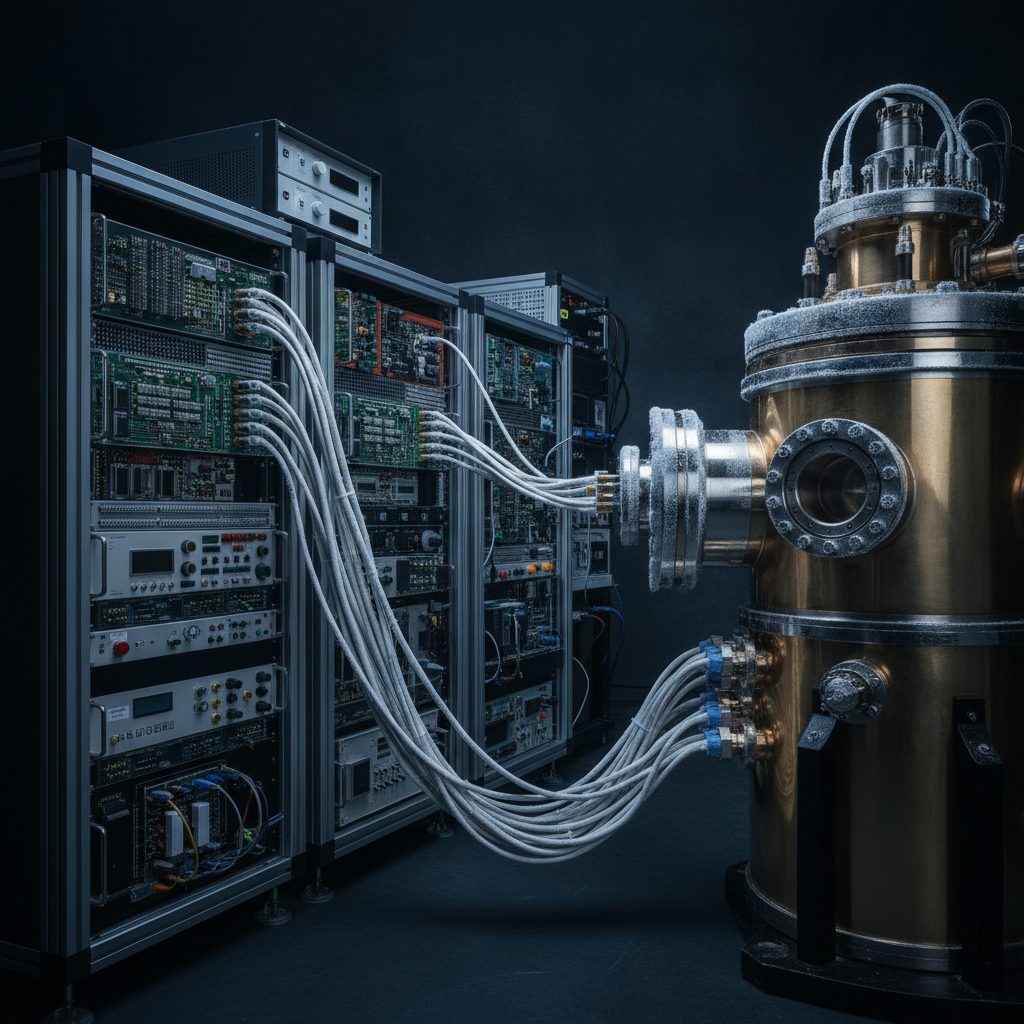
 Symbolbild · KI-generiert
Google's Quantum Milestone: What Error Rate Reduction Really Means

When Laboratory Data Moves Share Prices
Quantum computing stocks have always been sensitive to technical announcements — even when the direct path to company revenue is still years away. Google's recent claim of having reduced the error rate of logical quantum bits (qubits) by a factor of 40 is a textbook example of this market phenomenon: a credible laboratory proof is enough to recalibrate the valuation framework for the entire segment — at least in the short term.
For newcomers, it is important to understand what this advance means technically and why it still says nothing about actual revenues. Grasping that distinction allows investors to contextualise market reactions more accurately — and helps avoid the common mistake of equating laboratory milestones with business success.
Quantum Approaches Compared (–)
The Quantum Computer's Enemy: Why Error Rates Matter
Classical computers work with bits that are unambiguously either 0 or 1. Qubits, by contrast, can exist in so-called superpositions — they are simultaneously 0 and 1 until measured. This very property theoretically enables enormous computational parallelism, but it also makes the systems extremely susceptible to interference. Heat, electromagnetic fields, or even the slightest mechanical vibration can destroy the quantum state — a process physicists call decoherence.
The error rate describes how often a qubit adopts an incorrect state during a computational operation. High error rates force engineers to deploy so-called error correction codes: several physical qubits are linked together to simulate a single reliable "logical qubit". The lower the error rate of physical qubits, the fewer redundant qubits are needed for correction — and the closer the transition to practically usable quantum computing becomes.
Google's Willow chip is said, according to the company, to have demonstrated precisely this step: as the number of qubits grows, the error rate continues to fall rather than rise — a behaviour researchers describe as "below threshold" and which is considered a prerequisite for scalable error correction.
How Analysts Map Google's Progress onto Pure Plays
The interesting question for investors is why an advance by Alphabet (Nasdaq: GOOGL) — one of the world's largest technology companies — moves the share prices of smaller, specialised quantum firms. The logic follows a familiar pattern from the semiconductor industry: when a dominant player delivers a technological proof of concept, it validates the underlying technology for the entire sector and increases investor confidence in smaller competitors too.
In this context, Morgan Stanley has rated Quantinuum — a joint venture between Honeywell and Cambridge Quantum — as its preferred quantum stock. Quantinuum uses a different hardware approach from Google: trapped ions rather than superconducting qubits. Analysts argue that this technology already performs better on error rates today, but shows disadvantages in scaling speed.
D-Wave Quantum (NYSE: QBTS) pursues a fundamentally different path: quantum annealing rather than universal gate-based quantum computing. According to press releases, the company has delivered a quantum computer to Italy — a concrete order intake that is more informative for investors than pure laboratory results, because it evidences actual demand. Even so, the same caveat applies: a delivery contract is not a recurring revenue stream; what matters is whether it gives rise to repeat business.
| Company | Hardware Approach | Market Stage | Exchange |
|---|---|---|---|
| Alphabet (Google) | Superconducting qubits | Research / internal | Nasdaq: GOOGL |
| Quantinuum | Trapped ions | Cloud access / partnerships | Not listed |
| D-Wave Quantum | Quantum annealing | Hardware sales / cloud | NYSE: QBTS |
| IonQ | Trapped ions | Cloud access | NYSE: IONQ |
Cash Runway: The Underrated Metric in the Quantum Segment
The truly critical question for investors in pure-play quantum companies is not whether the technology will eventually work — that is now broadly considered settled. The question is: will capital last until the first sustainable revenues are generated?
The cash runway — a company's cash balance divided by its monthly consumption rate (burn rate) — indicates how many months a company can operate without fresh capital. For small caps in the quantum space that have yet to generate meaningful revenues, this figure is often alarmingly low. When the runway falls below twelve months, either a capital increase looms — diluting existing shareholders — or, in the worst case, insolvency.
An analogy from automotive history illustrates the mechanics: when the first petrol-powered vehicle drove in 1885, the technology was proven. But the companies that invested in building vehicle factories in 1890 needed capital for the entire period until a mass market emerged — and most did not survive that long. Quantum computing is playing out the same dynamic, just on a different timescale.
For investors, this means that even if Google's error rate announcement underscores the sector's long-term potential, it does not protect individual pure-play companies from short-term liquidity pressures. The dilution risk from new funding rounds remains a structural feature of the segment.
What Remains Once the Market Noise Settles
Google's progress in error correction is a genuine scientific step — not a marketing exercise. For the sector as a whole, it provides a stronger argument: fault-tolerant quantum computing is not a principle that exists only in equations, but a measurable engineering problem that can be solved.
For investors who are already in pure-play stocks or are considering them, several observation points follow. First, which approach — superconducting, trapped ion, or annealing — is furthest along its respective error rate curve. Second, how many quarters each company's cash runway covers. Third, whether concrete order intake already exists — as in D-Wave's Italian delivery — or whether only letters of intent and pilot projects are on the table. The latter generate press releases, but not yet balance-sheet revenues.
The sector remains highly speculative. Those who follow it should carefully distinguish between the technical progress of research and the operational progress of individual companies. The two rarely advance at the same pace.
Key Terms in the Quantum Field
- Qubit (Quantum Bit)
- The fundamental unit of computation in a quantum computer; thanks to superposition it can represent 0 and 1 simultaneously — unlike a classical bit, which is always one or the other.
- Decoherence
- Loss of the quantum state due to environmental influences (heat, electromagnetic interference). It is the primary cause of computational errors in quantum systems.
- Error Correction (Quantum Error Correction)
- A method in which several physical qubits are linked together to produce a reliable logical qubit. The lower the error rate, the fewer physical qubits are required to achieve this.
- Below Threshold
- The condition in which the error rate falls rather than rises as the number of qubits grows — a technical prerequisite for practically usable error correction.
- Cash Runway
- A company's cash balance divided by its monthly burn rate; indicates how many months the company can operate without raising new capital.
- Burn Rate
- A company's monthly net cash consumption in the absence of sustainable profits; a key metric for assessing financing risk in pre-revenue companies.
- Dilution
- A reduction in the value of existing shares caused by the issuance of new shares in a capital increase; a typical risk for quantum companies with negative cash flow.
- Pure Play
- A listed company whose business model is focused exclusively or predominantly on a single technology or sector — here: quantum computing without a diversified group structure.
⚠️ Important notice: This article is for informational and educational purposes only. It does not constitute investment advice, a recommendation, or a solicitation to buy or sell any security. Investments in small-cap exploration and mining companies carry a high risk, including the potential total loss of capital. Before making any investment decision, consult a registered financial advisor and conduct your own analysis. Aktienatlas-Redaktion is not responsible for decisions taken based on the content published here.
Educational content only, not investment advice. Small caps are highly speculative and total loss is possible.