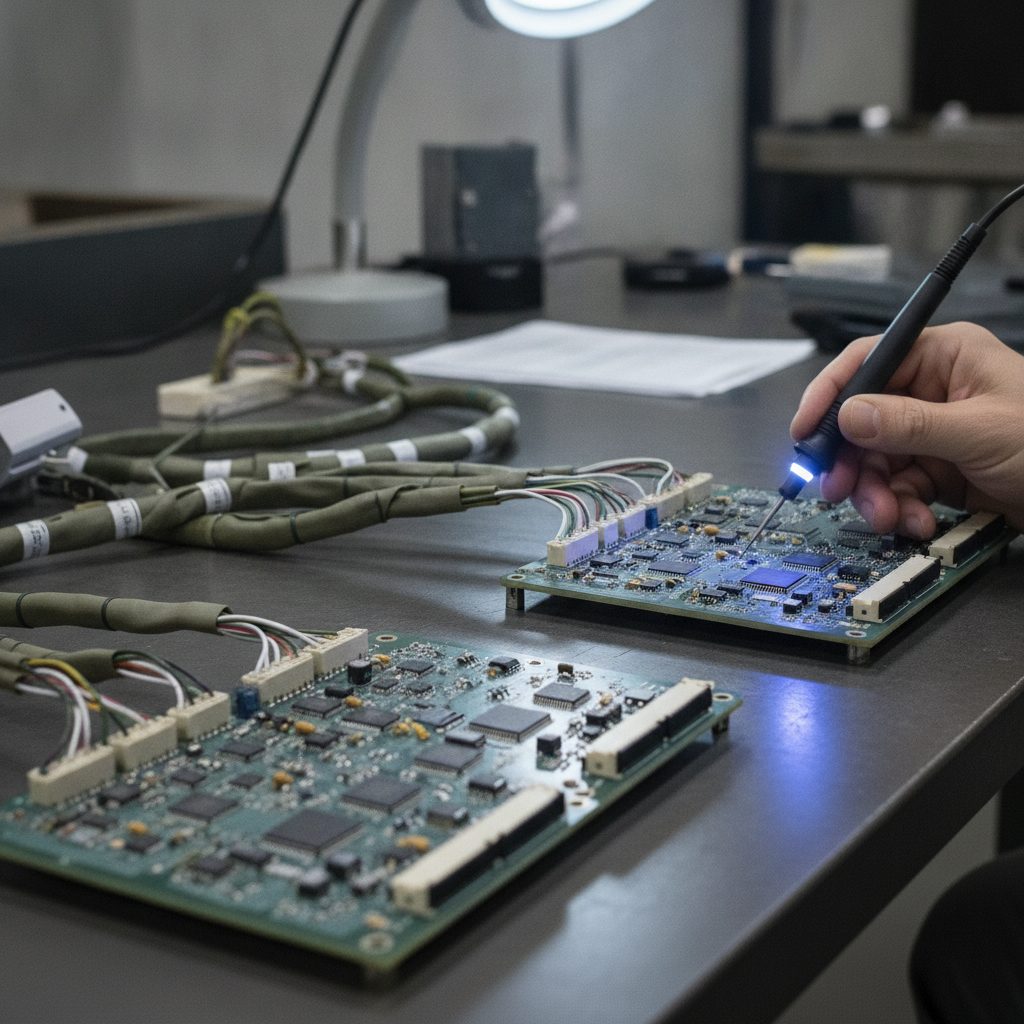
 Symbolbild · KI-generiert
From Prototype to Series Contract: Defense Small Caps and Long Cycles

First Flight, Ten Years of Patience — Why Prototypes Are Not Contracts
When a defense company sends a drone prototype airborne in front of rolling cameras, markets often react with immediate enthusiasm. News about autonomous escort drones — so-called Loyal Wingmen — lands in an investment environment already charged with narrative: AI-enabled systems, unmanned aerial combat, geopolitical rearmament. Yet behind the spectacular maiden flight lies a structural reality far more important to investors than the headline itself.
Saab has unveiled such a prototype of an autonomous loyal wingman drone through its A3 program, one that could potentially serve the Swedish Air Force — at the earliest in a decade, and only if the government actually commits to a procurement decision. That statement contains two critical variables: time and political will. Both are of central importance to investors in defense small caps.
Phases of a Defense Program (Stage)
The Structural Pattern Behind Defense Programs
Defense programs in democratic nations follow a multi-stage process model that unfolds over years or decades. Between the first proof of technological capability (Technology Readiness Level, or TRL) and a series production contract, the following phases typically occur:
- Concept and Technology Phase: Feasibility studies, initial laboratory models, simulation — often funded through self-investment or public funding.
- Demonstration Phase: A flight-capable prototype, public demonstration, initial evaluation by the prospective customer.
- Qualification and Certification Phase: Military airworthiness certification, cyber hardening, interoperability testing with existing platforms — this step alone typically takes three to seven years.
- Political Procurement Decision: Budget approval by parliament or government, frequently tied to defense policy priorities, coalition politics, and NATO planning cycles.
- Series Production and First Delivery: Only at this stage do predictable, recurring revenues materialize for contractors and suppliers.
This pattern is not an isolated case. The history of modern combat aircraft programs — from the Eurofighter to the F-35 to the Rafale — shows that even well-funded programs with strong industrial backing can suffer massive delays. For considerably smaller unmanned platforms, the requirements are similarly stringent, or even stricter, once autonomous decision-making capabilities come into play.
Milestone Payments as the Real Signal
For investors tracking small-cap suppliers in the drone space, prototype announcements are not the decisive signals — contract structures and their intermediate stages are. Two terms in particular must be clearly distinguished:
Framework agreements (also: Indefinite Delivery / Indefinite Quantity, IDIQ) establish a maximum procurement ceiling without guaranteeing binding order quantities. They signal that a supplier is qualified and preferred — but they generate no revenue yet. Only a firm fixed-price order (FFP) converts the framework into bookable revenue.
Milestone payments are contractually agreed partial payments triggered by the achievement of clearly defined technical or schedule milestones. They are critical for small suppliers because they extend the cash runway without immediately necessitating a capital increase (share issuance). When a small cap announces a milestone in a press release, careful reading is warranted: Is this a contractually secured payment, or merely the internal completion of a development phase with no external cash flow attached?
An analogous pattern emerged in the space sector: many satellite small caps issued a wave of Memoranda of Understanding (MoUs) and letters of intent between 2021 and 2023 — paper agreements with no binding force. Companies that failed to clearly distinguish this in their investor relations materials saw their share prices initially rise, then correct sharply when revenue growth failed to materialize.
Political Budget Decisions as a Source of Uncertainty
Defense procurement is not a purely industrial process. It is political. In parliamentary democracies, every major defense program must pass through budget committees multiple times, is subject to coalition negotiations, and can be delayed or cancelled by changes in government or shifts in foreign policy priorities.
For small-cap suppliers, this means: even if the technology is compelling and a framework agreement is in place, the political procurement decision can take years to arrive. Sweden, as a NATO member, faces pressure from the northeastern European security environment and is increasing its defense spending — which improves the structural backdrop. Nevertheless, the transition from program to budget line item remains a discretionary act entirely outside the control of any private company.
The same applies to the European FCAS program (Future Combat Air System) and the British Tempest project: both have been mired for years in politically complex coordination processes, even though technical demonstrators have long shown that the participating industrial consortia can deliver.
| Phase in the Defense Program | Relevance for Small-Cap Suppliers |
|---|---|
| Prototype / Maiden Flight | Technical proof — no revenue, no contract |
| Framework Agreement (IDIQ / MoU) | Qualification signal — no firm order quantities |
| Milestone Payment (contractual) | First external cash flow — extends runway |
| Firm Fixed-Price Order (FFP) | Bookable revenue — book-to-bill rises |
| Series Production | Recurring revenues — only now scalable |
What Investors Should Watch in Drone Small Caps
The program in question illustrates an industry-wide pattern that extends well beyond any single case. For investors monitoring small caps in the drone or defense segment, several structural reference points emerge:
Cash runway before euphoria: Small suppliers dependent on a series contract ten years out must cover their ongoing capital needs through other means — milestone payments, alternative contracts, or capital increases (share issuances). A capital increase dilutes existing shareholders and is therefore a central risk signal. The cash runway (cash on hand divided by the monthly burn rate) indicates how long the company can survive without new capital measures.
Book-to-bill as a temperature gauge: The ratio of order intake to realized revenue indicates whether a company is actually growing or merely filling its order books with non-binding letters of intent. A book-to-bill well above 1.0 backed by firm orders is a reliable signal; a high reading driven primarily by framework agreements should be interpreted with caution.
Total loss of capital risk is real: Defense small caps without a profitable core business are dependent on external financing. If a program is politically frozen, a capital increase falls through, or the runway runs out before the next milestone payment arrives, the value of a position can fall to zero. This total loss of capital is not a theoretical scenario — it is a structural risk that must be factored into every speculative defense investment.
This article is intended solely for financial education and does not constitute investment advice. Investments in small caps, particularly in early program phases, are highly speculative.
Key Terms at a Glance
- Loyal Wingman
- The concept of an autonomous or remotely piloted drone that accompanies manned combat aircraft, takes on assigned tasks, and functions as an extended sensor or weapons platform.
- Technology Readiness Level (TRL)
- A nine-level scale (NATO/EU) for classifying the maturity of a technology — from basic research (TRL 1) to proven, production-ready technology (TRL 9). A flight-capable prototype typically corresponds to TRL 6–7.
- Framework Agreement / IDIQ
- A contract that defines a maximum procurement ceiling but sets no binding minimum quantities. Only individual task orders generate bookable revenue.
- Milestone Payment
- A contractually agreed payment due upon reaching a defined development target. An important source of liquidity for capital-intensive early-stage projects.
- Book-to-Bill
- A metric: order intake divided by realized revenue in the same period. Values above 1.0 indicate growing order intake; values below 1.0 signal shrinking order books.
- Cash Runway
- The length of time a company can sustain operations with its current cash on hand before new capital is required (cash balance ÷ monthly burn rate).
- Dilution
- The reduction of existing shareholders' percentage ownership through the issuance of new shares as part of a capital increase. A frequently underestimated risk in speculative small caps.
- Total Loss of Capital
- Complete loss of value of an investment. For speculative defense small caps without profitable core revenues, a realistic scenario in the event of program cancellation or a capital shortfall.
⚠️ Important notice: This article is for informational and educational purposes only. It does not constitute investment advice, a recommendation, or a solicitation to buy or sell any security. Investments in small-cap exploration and mining companies carry a high risk, including the potential total loss of capital. Before making any investment decision, consult a registered financial advisor and conduct your own analysis. Aktienatlas-Redaktion is not responsible for decisions taken based on the content published here.
Educational content only, not investment advice. Small caps are highly speculative and total loss is possible.