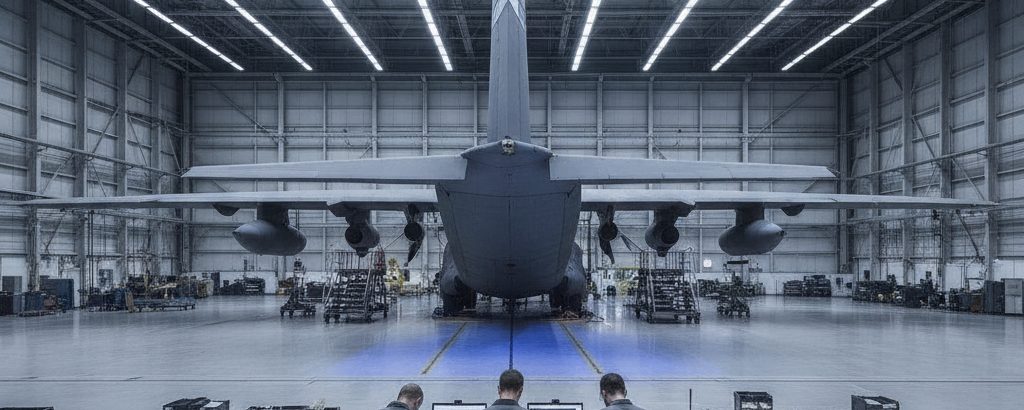
 Symbolbild · KI-generiert
FAA Certification as the Key: What Autonomous Cargo Aircraft Really Cost
When Capital Flies Faster Than the Aircraft
$60 million before the first unmanned test flight: the startup Poseidon Aerospace closed a funding round of this size without having demonstrated a single commercial operation. In the world of autonomous aviation, this pattern is not an exception — it is a structural feature of a sector built almost entirely on expectations. For investors in small and mid-cap technology stocks, a closer look at the underlying mechanics is worthwhile, because the valuation of such companies follows its own logic that differs fundamentally from that of profitable businesses.
The question to ask is not: "Is this a promising technology?" Rather: "What assumptions must hold true for the current company valuation to be justified — and how likely are those assumptions?" In autonomous cargo aviation, the answer to that question revolves almost entirely around a single factor: regulatory approval by the FAA.
Pilots, Costs, and the Promise of Automation
The economic thesis behind pilotless cargo aircraft is compelling at first glance: pilots account for a significant share of operating costs in the air freight industry — from salaries and training to rest requirements that severely constrain flight schedules. Eliminating this cost item could theoretically produce a far leaner cost structure than that of established freight carriers. Add to this the fact that an aircraft does not need sleep: autonomous systems could operate around the clock, provided maintenance and air traffic control allow it.
This approach is not new. Consider the transition from steam locomotive operators to automated subway trains, or pilotless cargo vessels in experimental service. Yet aviation and maritime transport differ fundamentally: airspace is tightly regulated, three-dimensional, and shared by civilian and military users. Every new class of aircraft must not only work technically but must also integrate into the entire airspace system — from communication with air traffic controllers to emergency procedures in the event of a system failure.

How Pre-Revenue Valuations Work in This Sector
When a company like Poseidon Aerospace raises $60 million before a test flight has taken place, investors are essentially paying for a combination of three factors: first, the technical team and intellectual property; second, the plausibility of the business model; and third — crucially — an implicit bet on the certification pathway.
This valuation logic is structurally similar to that of a biotech company in the pre-clinical phase: the intrinsic value of the business depends almost entirely on whether an external authority (there the FDA, here the FAA) gives the green light. One key difference, however, is that FDA approval processes are comparatively well documented and have been analyzed historically. For fully autonomous cargo aircraft at commercial scale, by contrast, no established FAA pathway yet exists — the regulatory framework is literally being developed in parallel with the technology.
This explains why funding rounds in this sector frequently occur before technical milestones are reached: investors secure a position at an early stage because they expect that later rounds — following a successful test flight or the first certification phase — will be significantly more expensive. That is not necessarily irrational, but it shifts the risk entirely onto early investors.
| Milestone | Regulatory Significance |
|---|---|
| First unmanned test flight | Technical proof of concept; no operating license granted |
| FAA Part 135 Waiver (limited) | Permission for specific test routes; no commercial operations |
| FAA Type Certificate | Basis for serial production and third-party operations |
| FAA Air Carrier Certificate | Required for commercial cargo operations |
What the Cash Runway Reveals — and What It Conceals
$60 million sounds like a lot. Whether it is sufficient depends entirely on the monthly burn rate — the pace at which the company consumes capital. In aerospace engineering, development costs are substantial: certification work, flight tests, redundancy systems, avionics — all of it costs money. A startup burning three to five million dollars per month has a cash runway of roughly twelve to twenty months. Is that enough to provide the regulatory evidence that follow-on investors will require before committing to the next round?
That is the real structural question. If FAA certification takes longer than the cash runway allows — which is far from rare in aerospace regulation — the company faces another funding round. That round may occur under worse conditions and almost inevitably involves dilution of existing shareholders: new shares are issued, and the percentage stake of existing investors decreases accordingly.
An analogous pattern emerged in the first generation of autonomous ground vehicles: between 2020 and 2023, several well-funded startups were forced to raise additional rounds or were acquired at significantly lower valuations despite technical progress, because the timeline to market approval was consistently underestimated.
Autonomous Cargo Logistics: Four Questions Before Any Assessment
For investors monitoring this sector, the Poseidon Aerospace example yields four structural questions that apply to any UAV logistics startup — regardless of the specific company:
1. Which certification pathway is the company on? An FAA waiver for a narrowly scoped test operation is fundamentally different from a Type Certificate or an Air Carrier Certificate. Some companies communicate regulatory interim steps as though they were commercial breakthroughs — that is misleading.
2. How long is the cash runway, and when is the next technical validation planned? If the two do not align, a dilutive funding round is likely.
3. What is the specific target route or segment? Domestic overnight cargo flights over sparsely populated terrain differ enormously — from a regulatory standpoint — from operations in dense airspace. Not every UAV logistics promise carries the same level of complexity.
4. How is the company capitalized, and who are its investors? Institutional investors with aerospace experience can draw on regulatory networks that may accelerate the certification process. That represents a qualitative difference compared with purely financial venture capital firms.
Key Terms for UAV Logistics Investors
- Pre-Revenue Company
- A company that has not yet generated any commercial revenue. Valuation is based solely on future cash flow assumptions that are not yet supported by market data.
- FAA Type Certificate
- Official approval issued by the U.S. Federal Aviation Administration confirming that an aircraft design meets safety requirements. A necessary — but not sufficient — prerequisite for commercial operations.
- Cash Runway
- The remaining operating period of a company based on its current cash reserves and monthly expenditure rate (burn rate). Calculation: cash balance ÷ monthly burn rate = months until insolvency without new financing.
- Dilution
- When a company issues new shares (e.g., through a capital increase), the percentage stake of existing shareholders decreases. Their voting rights and their claim on future profits are reduced accordingly.
- FAA Part 135 Waiver
- A special FAA authorization permitting air transportation operations under specific, restricted conditions. Not a substitute for full operating certification.
- Burn Rate
- A company's net monthly cash expenditures in the absence of positive cash flows. High burn rates combined with an unclear certification horizon significantly increase capital risk.
- Regulatory Risk
- The risk that a regulatory decision — here, FAA certification — fails to materialize, is delayed, or turns out negative, thereby calling the company's entire business model into question.
⚠️ Important notice: This article is for informational and educational purposes only. It does not constitute investment advice, a recommendation, or a solicitation to buy or sell any security. Investments in small-cap exploration and mining companies carry a high risk, including the potential total loss of capital. Before making any investment decision, consult a registered financial advisor and conduct your own analysis. Aktienatlas-Redaktion is not responsible for decisions taken based on the content published here.
Educational content only, not investment advice. Small caps are highly speculative and total loss is possible.