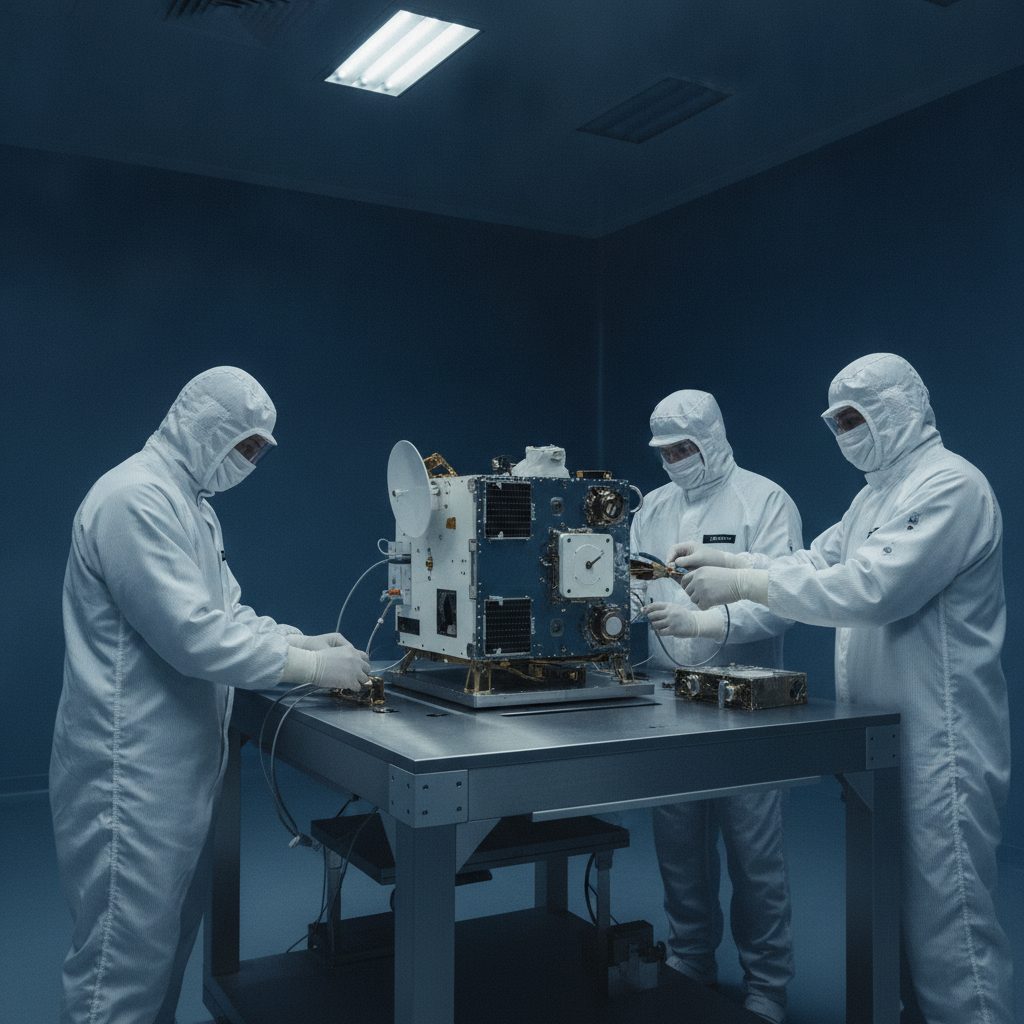
 Symbolbild · KI-generiert
Event Windows in Space Stocks: Volatility Without a Change in Value

When the Calendar Drives Prices — Not the Numbers
There are weeks in the space segment when investors and media alike zero in on a single focal point: an upcoming launch event, an anticipated contract, quarterly earnings, or an investor conference. During these phases, a stock's price can swing by double digits within just a few days — without the company having introduced a single new technology or earned one additional cent in revenue. This pattern is no coincidence; it is a structural characteristic of speculative small caps in the space sector.
Companies such as AST SpaceMobile (Nasdaq: ASTS), Firefly Aerospace, and Virgin Galactic (NYSE: SPCE) each represent very different business models — direct satellite communications to mobile devices, commercial launch vehicles, and suborbital tourism — yet they share the same phenomenon: their share price frequently reacts more strongly to upcoming events than to completed facts.
For investors new to space stocks, it is worth understanding exactly why this is the case — and what risks come with it.
Three Business Models, One Shared Price Pattern
To put the phenomenon in context, a brief look at the differences between the three companies is helpful:
| Company | Business Model | Typical Catalyst |
|---|---|---|
| AST SpaceMobile (ASTS) | Broadband satellite telephony directly to smartphones | Satellite launch, network coverage announcements, partnerships with mobile carriers |
| Firefly Aerospace | Small launch vehicles | Launch date, successful orbital insertions, NASA/DoD contracts |
| Virgin Galactic (SPCE) | Suborbital space tourism | Test flights, inaugural commercial flights, booking figures |
What all three have in common: they are in early to mid-development stages, have yet to generate stable, scalable revenues, and are therefore dependent on external capital inflows. This makes them vulnerable to what market observers call narrative-driven valuation — the share price reflects not earnings but expectations about the future.
The Mechanics of the Event Window: Expectation Beats Reality
An event window forms when a definable, time-limited decision is approaching: a launch date, a contract decision, an earnings call. This pattern is well documented in behavioral economics. Investors anticipate the outcome days or weeks in advance and buy accordingly — the price rises before a single new data point is confirmed.
This phenomenon has its own term in market jargon: "Buy the rumor, sell the news." Once the event occurs — even if the outcome is positive — many short-term investors sell their position because the anticipated premium was already priced in. The price falls even though the result was good.
The space sector adds specific uncertainty factors on top of this: launches are weather-dependent, can be postponed for technical reasons, and even successful launches do not automatically translate into commercial profitability. A satellite launch is an operational milestone — not a revenue generator in itself.
What Pulls Fundamentals and Price Movements Apart
In mature markets, a share price aligns over the long term with metrics such as revenue, EBITDA, or free cash flow. In the speculative space segment, many of these metrics are either not yet available or are negative. Instead, so-called soft indicators dominate the valuation:
- Technological milestones (first successful orbit, demonstration of network capability)
- Partnership announcements with telecommunications companies or government agencies
- Letters of Intent (LoI), which do not yet represent firm purchase commitments
- Public funding / grants (approved but not yet disbursed)
Precision matters here: a Letter of Intent is not a firm order. A statement of intent from a government customer does not equal a binding framework agreement, and a framework agreement (IDIQ type) only sets a maximum ceiling — with no guaranteed call-off. Investors who equate such announcements with secured revenue systematically underestimate fundamental risk.
The pattern becomes even clearer when looking at cash runway: many space small caps burn several million dollars a month without generating meaningful revenues. Cash runway — the period the company's existing capital can sustain current spending — is one of the most important metrics, yet it often gets overshadowed by more spectacular headlines. When the runway is running short, a dilutive capital increase (share issuance) becomes a real threat to existing shareholders.
Event Windows as a Learning Opportunity — Not an Entry Signal
For investors new to space stocks, catalyst weeks offer an instructive but also dangerous backdrop. Instructive, because they demonstrate in concentrated form how markets handle uncertainty. Dangerous, because media attention tends to be at its highest exactly when risk is greatest.
A useful analogy from the biotech world: ahead of Phase III trial data releases, biotech stocks often rally sharply. If the data are good but no better than expected, the price can still fall — because the expectation was already priced in. In the space segment, a satellite launch fulfills the same psychological function as trial data in biotech: it is binary (success or delay/failure), time-defined, and highly visible in the media.
It is also important to understand the asymmetry: when an outcome is positive, the price often gives back part of the preceding premium. When an outcome is negative — launch abort, satellite failure, disappointing quarterly results — the price reaction can be significantly more severe, because confidence in the timeline also suffers.
Speculative space stocks therefore carry a substantial risk of loss. In an extreme case — insolvency due to an exhausted cash runway or a total technical failure — a total loss of capital is a real scenario. This is not a theoretical warning; it is a documented outcome from past space small caps that disappeared from the market despite promising technology.
What Investors Can Take Away from Catalyst Weeks
Event windows in the space sector are valuable observation opportunities — they show market mechanics operating in their purest form. Anyone who understands the mechanics will recognize three recurring patterns:
- Expectation buildup ahead of the event: The price rises, often without any new information, as investors position themselves.
- The event occurs: Even with a positive outcome, profit-taking frequently follows.
- Re-rating after the event: Only after the catalyst does it become clear whether the company is operationally on track — or whether the narrative has outrun reality.
For evaluating a space company beyond catalyst hype, the following questions remain central: What is the current cash runway? Are there binding call-off orders, or only letters of intent? What specific revenues are planned for which timeframe — and on what assumptions do those plans rest? These questions can be worked out from published company reports and quarterly filings, and they are far more reliable reference points than the price reaction to an upcoming launch date.
Key Terms at a Glance
- Event Window (Catalyst Window)
- A time-limited period in which a defined event (launch, earnings, contract announcement) dominates price movement. Characterized by elevated volatility before and after the event, often independent of the company's fundamental value.
- Buy the Rumor, Sell the News
- A market pattern in which investors price in anticipated positive events in advance and sell when the event occurs — even when the outcome is positive. Frequently results in price declines immediately after what is considered a positive announcement.
- Cash Runway
- The period a company can sustain operations with its existing cash balance at a constant monthly spending rate (burn rate), without raising new capital. The shorter the runway, the higher the risk of a dilutive capital increase (share issuance).
- Letter of Intent (LoI)
- A non-binding expression of intent between two parties. Not an order, not a revenue guarantee. In the space sector, frequently confused with binding contracts.
- Dilution
- A reduction in the value of existing shares caused by the issuance of new shares in a capital increase. A structural risk for small caps with negative cash flow that can significantly weigh on the returns of long-term investors.
- Narrative-Driven Valuation
- A share valuation based not on current earnings or revenues, but on the story of a possible future. Typical of early-stage technology companies; vulnerable to sharp corrections when the narrative loses credibility.
- Total Loss of Capital
- A scenario in which the full value of an investment is lost — for example through insolvency, delisting, or the technical failure of the business model. A real, though not inevitable, risk in speculative space small caps.
⚠️ Important notice: This article is for informational and educational purposes only. It does not constitute investment advice, a recommendation, or a solicitation to buy or sell any security. Investments in small-cap exploration and mining companies carry a high risk, including the potential total loss of capital. Before making any investment decision, consult a registered financial advisor and conduct your own analysis. Aktienatlas-Redaktion is not responsible for decisions taken based on the content published here.
Educational content only, not investment advice. Small caps are highly speculative and total loss is possible.