 Symbolbild · KI-generiert
Drone Defence Components: How Suppliers Profit from the C-UAS Market
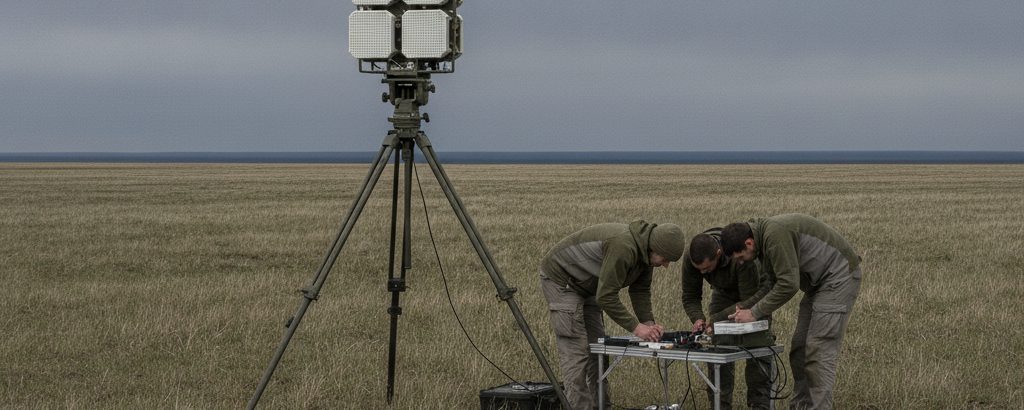
When drones become a mass phenomenon, defence must become affordable
Only a few years ago, drone defence was considered a niche topic for special forces and government clients with eight-figure budgets. Today, commercial drones patrol airports, prison facilities, critical infrastructure and active conflict zones alike. The proliferation of unmanned aerial systems — from simple consumer models to tactical FPV drones — has fundamentally transformed demand for counter-UAS (C-UAS) solutions: the focus has shifted away from heavy, static systems built for large clients towards compact, cost-effective, and rapidly deployable solutions.
Teledyne FLIR Defense has unveiled the Ranger R10-3DX, a compact 3D radar designed explicitly for affordability and operational flexibility. The manufacturer positions the system as an early-warning and tracking solution for government agencies, armed forces, and potentially non-governmental clients with limited budgets. For investors in the defence segment, this is not an isolated product event — it is a symptom of a broader market shift.
C-UAS Market Entry Barriers by System Type (Levels (1–3))
From heavy weapons system to modularly deployable subsystem
To understand why this shift matters for small-cap investors, it is worth examining the structure of the defence industry. Traditionally, a small number of prime contractors dominate the market: they win major contracts and subcontract portions of the work to a network of suppliers. A small company producing radar sensors, signal-processing software, or communications modules can thus participate in contracts as a sub-supplier without needing to compete as a primary bidder.
The C-UAS market is now developing in a direction that substantially broadens this supply chain. As defence systems must become smaller, more modular, and more affordable, demand rises for specialised individual components: compact radar sensors, RF classification software, electro-optical tracking systems, jamming modules, and AI-driven threat assessment. Each of these categories can be served by specialised small- and mid-cap suppliers.
An analogy from another technology sector illustrates the principle clearly: when smartphones became mass-market products, it was not only the large handset manufacturers that benefited — a broad supply chain of chip designers, camera module makers, and antenna specialists profited too. The democratisation of drone defence could follow a similar pattern.
Certification and interoperability — the underestimated obstacle
The C-UAS market is not a free market in the conventional sense. Government agencies and armed forces do not simply procure the cheapest or most technically impressive product — they require certifications, type approvals, and interoperability evidence with existing systems. In the United States, for example, C-UAS systems must frequently be integrated into the DoD approval process and tested for compatibility with battle management systems.
For small-cap suppliers, this means that the path from a technically mature product to a first paid contract can take years and tie up significant capital resources. Those without sufficient liquidity risk not surviving the certification phase — a classic cash runway crunch scenario.
At the same time, a successful certification can represent a lasting competitive advantage: government agencies tend towards path dependency — once a supplier is embedded in the system, it is favoured for follow-on contracts. This explains why established subsystem suppliers in the defence industry often achieve disproportionately high margins, while new entrants may wait a long time for their breakthrough despite strong technology.
The C-UAS market also has a geopolitical dimension: experience from ongoing conflicts has demonstrated that low-cost drones can create strategic asymmetries. This increases political pressure on governments to accelerate procurement processes — which could potentially lower the barriers to market entry for smaller suppliers.
| System Type | Typical Deployment Profile | Market Entry Barrier |
|---|---|---|
| Large Static Systems | Fixed bases, critical infrastructure | Very high (prime contractor structure) |
| Mobile Mid-Tier Systems | Field camps, convoys | High (framework agreement + type approval) |
| Compact Lightweight Systems | Single operators, rapid deployment | Medium (growing segment, certification remains) |
| Subsystems / Components | Integration into third-party systems | Dependent on integration partner |
Ondas Holdings and Red Cat Holdings — two approaches within the C-UAS ecosystem
Beyond the Teledyne FLIR product signal, the market also illustrates how different small-cap strategies within the drone and C-UAS segment can look. Ondas Holdings (Nasdaq: ONDS) recently announced an AI platform collaboration under the name "Regna" with Palantir Technologies — a move that directs its focus towards software-driven drone analytics and reconnaissance. The market rewarded the announcement with a short-term share price rise, though the substance of the agreement — whether a letter of intent or a binding contract — remains a critical point for investors to examine.
Red Cat Holdings (Nasdaq: RCAT), by contrast, has unveiled its own drone type with the TRICHON, placing it more on the offensive side of the ecosystem than the defensive. For C-UAS investors, this distinction matters: building drones draws on different demand flows than defending against them.
Both examples illustrate a fundamental market logic: in the early stages of a technology cycle, many small suppliers with differing approaches coexist. Which of them gain market share over the long term depends on certification success, partner structures, and — for loss-making companies — on the ability to secure sufficient capital without excessively diluting existing shareholders.
What investors can take away from the supplier principle
The signal sent by the Ranger R10-3DX from Teledyne FLIR Defense is not a buy signal for any particular share — it is a structural indicator: the C-UAS market is maturing, and maturity means modularisation. When platforms become modular, value creation is distributed more broadly along the supply chain.
For investors with an interest in the defence segment, this means looking beyond the well-known prime contractors and analysing the second and third tiers of the supplier pyramid: who supplies the sensors? Who develops the classification software? Who manufactures the communications modules? These questions often lead to smaller, less widely followed companies — with correspondingly higher risk, but also potentially different return profiles than the large systems integrators.
What remains decisive is the distinction between companies that can already demonstrate firm order backlogs and those still in the certification or pilot phase. The book-to-bill ratio — order intake divided by revenue — is one of the most meaningful metrics in the defence industry. A value above 1.0 signals that more orders are coming in than are being fulfilled — a growth indicator. Values below this level point to stagnation or decline.
Key terms in drone defence and defence procurement
- Counter-UAS (C-UAS)
- An umbrella term for systems, procedures, and technologies used to detect, track, and neutralise unmanned aerial systems (UAS). Encompasses radar, optical sensors, jamming, directed energy, and kinetic intercept methods.
- Prime Contractor
- The lead contractor in defence procurement. Signs the contract with the government client and coordinates the network of sub-suppliers. Examples include Lockheed Martin, Northrop Grumman, and Thales.
- Framework Agreement
- An agreement that sets a maximum procurement volume but does not guarantee a firm call-off. Only the specific individual call-off (firm order intake) creates a binding revenue commitment.
- Book-to-Bill Ratio
- Order intake divided by revenue over a given period. A value above 1.0 signals growth (more orders received than fulfilled). In the defence industry it is regarded as an early indicator of future revenue development.
- Cash Runway
- The period for which a company can sustain operations using its current liquid assets at a given monthly burn rate, before new capital is required. A short runway increases the risk of dilutive capital increases.
- Dilution
- When a company issues new shares to raise capital, the percentage ownership of existing shareholders decreases. Frequent capital increases can depress the share price despite operational growth.
- Interoperability
- The ability of a system to work together with other systems from different manufacturers. In the military context, this is often a prerequisite for procurement decisions and a central criterion in certification procedures.
⚠️ Important notice: This article is for informational and educational purposes only. It does not constitute investment advice, a recommendation, or a solicitation to buy or sell any security. Investments in small-cap exploration and mining companies carry a high risk, including the potential total loss of capital. Before making any investment decision, consult a registered financial advisor and conduct your own analysis. Aktienatlas-Redaktion is not responsible for decisions taken based on the content published here.
Educational content only, not investment advice. Small caps are highly speculative and total loss is possible.