 Symbolbild · KI-generiert
Drone Defence Architecture: What Book-to-Bill Reveals for Small Caps
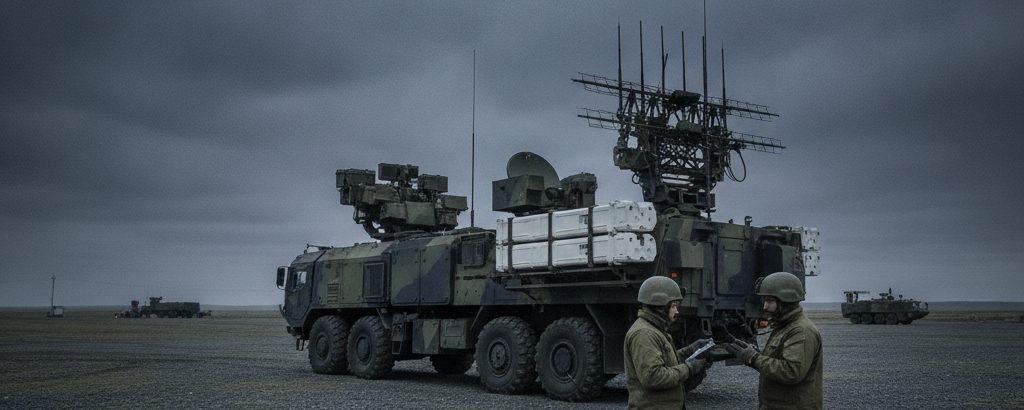
When a single system must track hundreds of drones simultaneously
In a world where commercial drones have evolved from hobbyist toys to tactical weapons systems within just a few years, defence architects face a fundamental question: how do you protect troops and critical infrastructure when threats no longer arrive as individual, expensive missiles, but as cheap swarms of dozens or hundreds at a time?
London-based defence company Helsing has put forward a conceptual response with its Contra platform. The system relies on an AI-powered architecture that, according to the company, is capable of simultaneously tracking and engaging hundreds to thousands of drone and missile threats — including two newly unveiled interceptors. Whether and to what extent these performance claims will be validated in operational use remains to be seen.
For investors following defence small caps, this moment is instructive — though not for the reasons one might initially assume. The real question is not whether the technology sounds impressive, but rather: how does this translate into scalable, predictable revenue growth?
Contract types in the defence market by binding force (Level (1–4))
Structural shift in demand meets a fragmented market
The need for drone defence has grown structurally — this is not speculation, but a response to a changed picture of modern warfare. Low-cost unmanned aerial vehicles have established themselves as an asymmetric weapon: minimal cost on the attacker's side, high defensive expenditure on the defender's side. The U.S. armed forces, European NATO partners and numerous other nations have recognised this imbalance and are increasing their procurement activities accordingly.
At the same time, new technological requirements are emerging: electronic warfare against GPS-guided drones, resilience in radio-controlled environments, and the ability to operate on the move — systems must be able to manoeuvre alongside mobile units rather than defending fixed positions. These requirements are pushing system architectures towards modular, networked and AI-assisted solutions, away from individual static gun emplacements.
For small and medium-sized defence companies, this means: the market is growing in real terms, but it is fragmented. Alongside established defence primes, numerous start-ups and smaller specialist suppliers are entering the segment — from hardware manufacturers to software providers and systems integrators. This fragmentation creates both opportunities and considerable uncertainty.

Demand signal ≠ order backlog: the crucial distinction
James Slider, CEO of Performance Drone Works, put the dilemma plainly: positive signals from the Pentagon exist, but the industry needs "sustained, normalized demand" — a consistently normalised order pipeline rather than isolated political gestures. This distinction is critical for small listed companies from a capital perspective.
In the defence industry there is a clear conceptual hierarchy that investors should understand:
- Letter of Intent (LOI): A non-binding expression of interest with no payment obligation.
- Framework agreement: Defines maximum call-off volumes and terms, but does not yet contain a firm purchase order.
- Firm call-off / order intake: A binding order with a specific delivery quantity and remuneration — only this counts towards the order backlog.
Technology presentations such as the Contra system typically sit at one of the first two levels at the time of their announcement. That is not without value — initial demonstration projects establish references, open the door to follow-on contracts and increase the strategic worth of a company. But a product presentation is not revenue.
The book-to-bill ratio (order intake divided by invoiced revenue) is in this context the most precise leading indicator: if it remains consistently above 1.0, the order backlog is growing faster than revenue — the company has tailwind. If it falls below 1.0, more is being invoiced than is coming in as new orders. For small-cap investors, it is one of the most reliable publicly available metrics in the sector.
| Contract type | Binding force | Counts towards order backlog? |
|---|---|---|
| Letter of Intent (LOI) | None | No |
| Framework agreement | Conditional | Only upon firm call-off |
| Firm call-off / order | Binding | Yes |
| Prototype contract (OTA) | Limited | Partly, depending on contract |
System architecture as a valuation driver — and as a risk factor
The shift towards AI-powered, networked drone defence systems has direct valuation implications. Platform providers whose systems function as nodes within larger defence networks can, in theory, generate network effects and lock-in advantages: once integrated into an infrastructure, a supplier is less likely to be replaced. This explains why investors often accept higher revenue multiples for such companies.
Yet this is precisely where an underappreciated risk lies: complex integrated systems mean longer development cycles, more expensive certification processes and greater capital intensity in the pre-revenue phase. For small-cap companies without a profitable core business, this creates a significant cash runway risk: if the money runs out before the first series contract arrives, the result is either a dilutive capital increase — or, in the worst case, a total loss of capital for shareholders.
A historical analogy illustrates the pattern: in the early phase of the UAV market in the 2000s, numerous small systems integrators entered the market with promising demonstrators. Only a handful survived the gap between initial demonstration and first series contract without significant dilution or acquisition by a large prime. Today, the counter-UAS segment presents a structurally similar situation.
What remains when the product launch fades
The drone defence segment offers real structural demand — that is the core of the current market dynamic. New system architectures that use AI to synchronise sensor arrays, data processing and intercept logic are not marketing hyperbole, but a technical necessity given the scaling threat of drone swarms.
For small-cap investors, however, the instructive lesson from this segment is: technology promises and market demand are necessary but not sufficient conditions for a viable investment thesis. The decisive question is whether a company can cross the bridge from demonstration to normalised order flow — without burning through its shareholders' capital.
The book-to-bill ratio, the published order backlog and the remaining cash runway are not abstract metrics: they are the indicators that make visible the distance between a company that is genuinely scaling and one that is merely pitching well.
Key terms for the defence market
- Book-to-bill ratio
- The ratio of order intake to invoiced revenue over a given period. A value above 1.0 signals order backlog growth; below 1.0 indicates a shrinking backlog.
- Order backlog
- The total value of all binding orders received but not yet invoiced. It serves as a leading indicator of future revenue.
- Framework agreement
- A contract that defines terms and maximum volumes without containing firm order quantities. Only a specific call-off becomes revenue-relevant.
- OTA (Other Transaction Authority)
- A procurement instrument of the U.S. Department of Defense used for prototype and research contracts, enabling faster award but offering fewer volume guarantees than traditional defence contracts.
- Cash runway
- The number of months a company can sustain operations with its current liquid assets at a given monthly expenditure rate (burn rate) before requiring fresh capital.
- Capital increase / dilution
- The issuance of new shares to raise fresh capital. This increases the total number of shares and reduces the percentage stake of existing shareholders in the company's value.
- Counter-UAS (C-UAS)
- Technologies and systems for detecting, tracking and neutralising unmanned aerial vehicles (drones). Encompasses electronic, kinetic and AI-based methods.
- Lock-in effect
- A situation in which a customer is tied to a platform or technology because switching would entail high costs or integration challenges — generating recurring revenue for the provider.
⚠️ Important notice: This article is for informational and educational purposes only. It does not constitute investment advice, a recommendation, or a solicitation to buy or sell any security. Investments in small-cap exploration and mining companies carry a high risk, including the potential total loss of capital. Before making any investment decision, consult a registered financial advisor and conduct your own analysis. Aktienatlas-Redaktion is not responsible for decisions taken based on the content published here.
Educational content only, not investment advice. Small caps are highly speculative and total loss is possible.