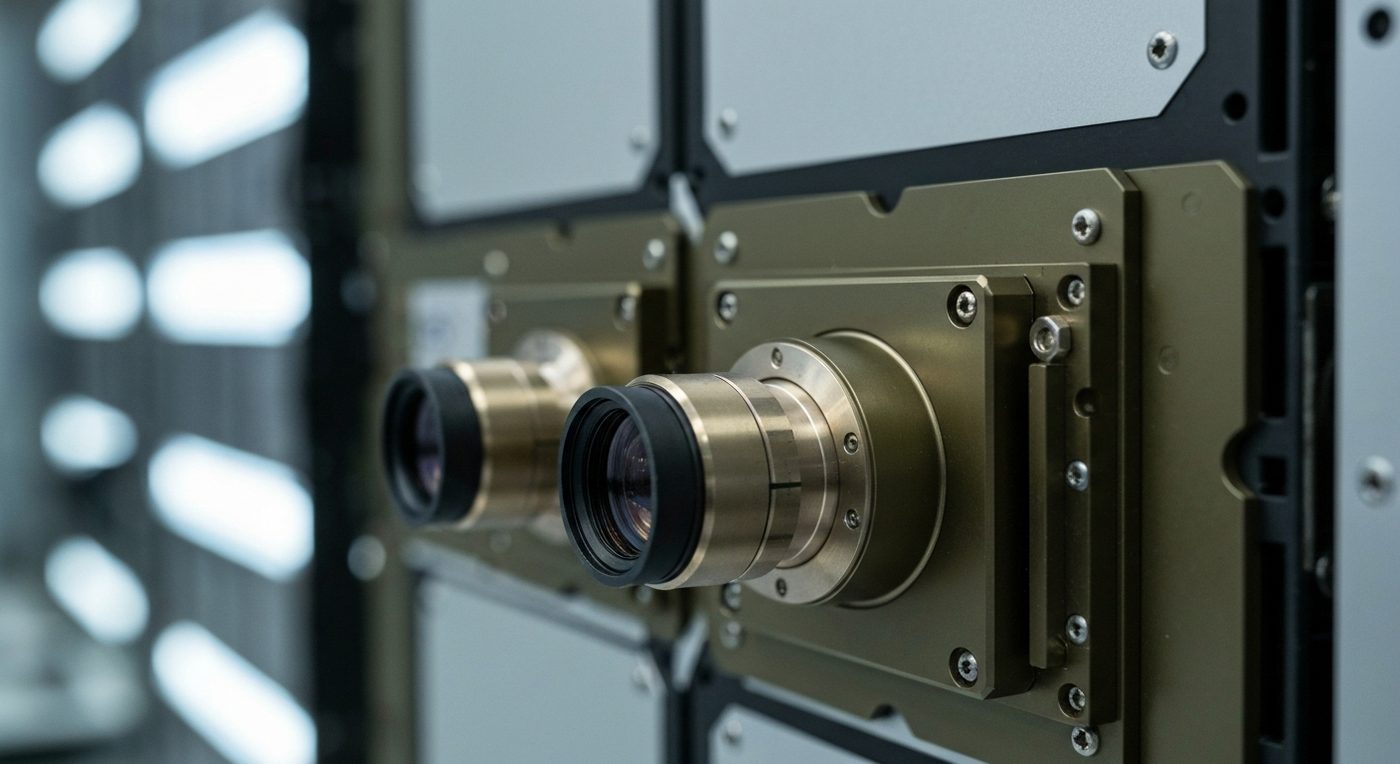
 Symbolbild · KI-generiert
Demonstration Contracts in Orbit: What Navy Awards Mean for Space Start-Ups

When a Start-Up Lands on the Pentagon's Shopping List
A small space company wins a multi-million-dollar contract from the U.S. military — it sounds like a stock market fairy tale. Yet the underlying pattern is structural and repeatable: K2 Space, a start-up specializing in low-cost satellites, has received a contract worth $22.9 million from the U.S. Space Force to demonstrate optical laser communication terminals aboard two of its own satellites in orbit. The goal is to connect military systems in space via laser light — a technology that offers significantly higher data rates and lower susceptibility to interception than conventional radio-frequency links.
For investors new to defense and space stocks, this contract is a textbook case: it shows how government procurement works, what opportunities and limitations such contracts offer — and why the difference between a demonstration project and a secured production order is critical for investors.
Government Procurement as a Market-Entry Strategy for Small Vendors
The United States has deliberately opened up space procurement in recent years. Agencies such as the Space Development Agency (SDA) and the Defense Innovation Unit (DIU) intentionally award so-called Other Transaction Authority (OTA) contracts to non-traditional defense suppliers — that is, start-ups that have not yet built a long track record in the Pentagon ecosystem. The rationale: commercial innovation should flow more quickly into military capabilities, bypassing the lengthy bureaucratic process of traditional procurement programs.
Optical communication in orbit — also referred to as Optical Inter-Satellite Links (OISL) or laser feeder links — is a strategically coveted segment. Compared with radio frequencies, laser links offer substantially higher bandwidth and are harder to jam or intercept, making them particularly attractive for military applications. Large players such as Northrop Grumman and Raytheon are also working on related systems, but specialized start-ups can penetrate niches that appear too small or too experimental for large corporations.
From Demonstration to Series Production: The Critical Gap
This is the core mechanism investors need to understand. Government demonstration contracts — often called Rapid Prototyping or Technology Maturation contracts — follow a three-stage pattern:
- Demonstration: The company proves that the technology works in real-world conditions. Revenue flows in, but it is one-time and project-bound.
- Qualification: If the contracting authority evaluates the results positively, a formal technical qualification phase follows. This phase often generates costs without immediately generating new revenue.
- Program Entry: Only once the technology is incorporated into a regular procurement program do stable, recurring orders with predictable revenue materialize.
Years can pass between Step 1 and Step 3 — or the program may be cancelled, reprioritized, or handed to a larger vendor. A well-known industry analogy: many small satellite operators that won demonstration contracts for Earth-observation payloads in the 2010s never reached series production, because established vendors with greater lobbying power captured the follow-on business.
The book-to-bill ratio — the quotient of new order intake to revenue recognized in the same period — is the most important indicator here. A book-to-bill above 1.0 signals that a company is winning new orders faster than it is billing existing ones — a growth signal. If it remains persistently below 1.0, the order backlog is shrinking even as current revenue continues to flow.
| Contract Type | Revenue Impact | Follow-On Order Guaranteed? |
|---|---|---|
| Demonstration Contract (OTA) | One-time, project-bound | No |
| Framework Agreement (IDIQ) | Callable up to maximum ceiling | Only upon individual task order |
| Firm Order / Production Contract | Predictable, recurring | Yes, contractually secured |
Cash Runway, Dilution, and the Risk of the Long Wait
For publicly listed small-cap companies at this stage — or for start-ups approaching an IPO — an additional dimension comes into play: the financing structure. A demonstration contract worth $22.9 million sounds like a significant sum. Yet for a company simultaneously developing, testing, and commercializing satellites, the monthly burn rate — the rate at which cash is consumed — can quickly climb into the single-digit millions per month.
The cash runway — the remaining time until liquid funds are exhausted (cash balance ÷ monthly burn rate) — becomes the central metric. If the contract is insufficient to fund operations through to the next milestone, a capital increase (share issuance) becomes unavoidable — and with it, dilution of existing shareholders. Depending on the size of the new share issuance, each existing shareholder's percentage stake in the company decreases, even if the share price remains temporarily stable.
A further risk: government programs can be frozen or cancelled for political or budgetary reasons. Numerous suppliers in the orbit of NASA's Constellation program experienced this firsthand when it was abruptly cancelled in 2010 — companies that were heavily concentrated on that single customer lost their primary revenue source overnight.
What Demonstration Contracts Really Signal as Leading Indicators
Despite all the risks, government demonstration contracts are a meaningful signal — if interpreted correctly. They confirm that a technology has cleared the first hurdle of government procurement: the technical credibility review. For a start-up like K2 Space, a Space Force contract signals that the technology not only works in the laboratory, but that a well-funded, demanding customer considers it worth demonstrating.
From a market perspective, investors can treat such contracts as early data points in a long valuation chain: Has a follow-on contract covering a qualification phase been announced? Are there signs of interest from additional agencies — such as NATO or allied armed forces? Is the order backlog growing faster than the burn rate? These questions, not the contract announcement itself, determine the fundamental quality of such a company over the medium to long term.
The space sector is undergoing a period of structural transformation: satellites are becoming smaller, cheaper, and more modular; laser communication is increasingly displacing conventional radio-frequency links; and military space architectures are being decentralized. In this environment, specialized niche vendors offer genuine technological leverage — but also a risk profile that broadly diversified large corporations do not carry.
Key Terms for Defense and Space Investors
- Demonstration Contract (OTA – Other Transaction Authority)
- A flexible U.S. government contract awarded outside traditional procurement regulations. It enables non-traditional vendors to access the market but carries no guarantee of follow-on orders.
- Book-to-Bill Ratio
- Order intake ÷ revenue in a given period. A value above 1.0 indicates order growth; below 1.0 signals that the order backlog is shrinking.
- Cash Runway
- Cash balance ÷ monthly burn rate = number of months a company can operate without raising new capital. When the runway falls below 12 months, the risk of an emergency financing round increases significantly.
- Dilution
- When the percentage stake of existing shareholders decreases as a result of new shares being issued in a capital increase, this is called dilution — even if the absolute share price remains stable.
- Optical Inter-Satellite Link (OISL)
- A laser-based link between satellites in orbit. Enables higher data rates and better interception security than radio-frequency (RF) links.
- IDIQ Contract (Indefinite Delivery / Indefinite Quantity)
- A framework agreement that defines a ceiling value but only becomes a real order through individual task orders. Not to be confused with a firm production contract.
- Burn Rate
- A company's monthly cash outflow. The higher the burn rate relative to the cash balance, the faster the next required funding round approaches.
⚠️ Important notice: This article is for informational and educational purposes only. It does not constitute investment advice, a recommendation, or a solicitation to buy or sell any security. Investments in small-cap exploration and mining companies carry a high risk, including the potential total loss of capital. Before making any investment decision, consult a registered financial advisor and conduct your own analysis. Aktienatlas-Redaktion is not responsible for decisions taken based on the content published here.
Educational content only, not investment advice. Small caps are highly speculative and total loss is possible.