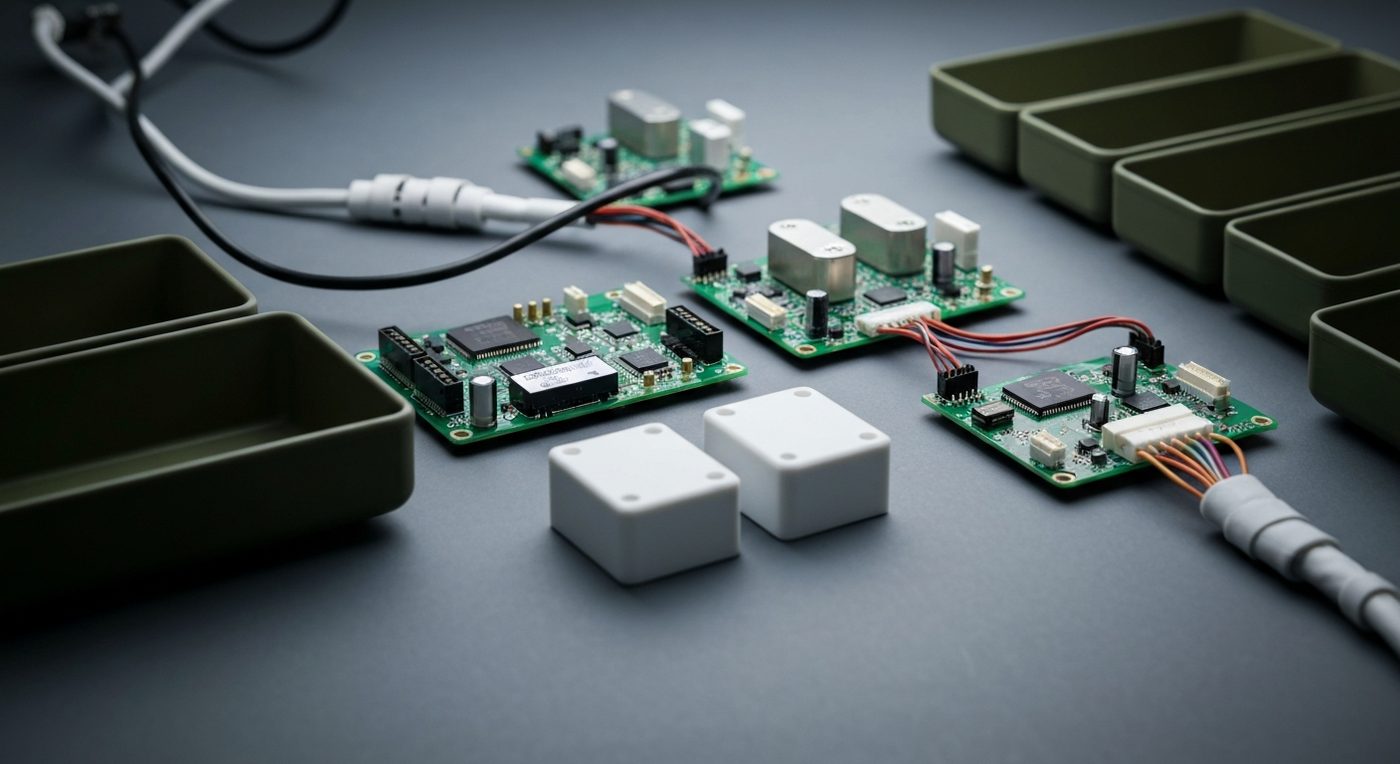
 Symbolbild · KI-generiert
Counter-Drone Procurement: When Price Rewrites the Rules of Competition

$150,000 Per Unit: A Number That Reorganizes an Entire Sector
Anyone who associates defense procurement with phrases like "multi-billion framework agreement" or "decades-long system integration" will pause at the U.S. Army's latest Request for Information (RFI). The Army is seeking a Next Generation C-sUAS Missile — an interceptor missile against small unmanned aerial systems (sUAS) — that must cost less than $150,000 per unit and be compatible with Raytheon's Coyote launcher. For a sector where even mid-tier defense systems routinely reach seven figures per unit, this is an exceptionally hard price ceiling.
For investors holding small caps in the defense sector, that number carries more weight than a technical specification. It is a price signal that could restructure the entire supply chain — and with it, who wins contracts in this market going forward.
Price Range: C-sUAS Interceptor Missile vs. Comparable Systems (USD)
From Gold-Plated Programs to Cost Discipline: How Solicitations Shape the Market
To appreciate the significance of this shift, it helps to understand the procurement logic of defense ministries. Traditionally, weapons systems are developed and produced by established prime contractors — large defense conglomerates such as Raytheon (RTX), Northrop Grumman, or L3Harris — through long development cycles. These companies bring decades of experience with military quality standards, but also correspondingly high overhead structures.
A per-unit price limit of $150,000 shifts that logic. Large corporations with complex overhead structures often cannot competitively meet such price points without relying on specialized suppliers or radically streamlining their operations. This is precisely where room opens up for smaller, technology-focused companies: suppliers of miniaturization solutions for propulsion and ignition, software firms developing guidance algorithms, or manufacturers of low-cost sensor modules.
The compatibility requirement with the Coyote launcher is also a strategic signal: the interceptor system is intended to integrate into existing infrastructure rather than requiring an entirely new platform. That lowers the barrier to entry for new competitors — but only for those who master the technical interfaces of the Coyote system.
The Ukraine Lesson: Adaptability Beats Quantity
Anyone looking at the counter-drone debate purely through the lens of hardware production is missing a critical dimension. The conflict in Ukraine has been generating continuous field data for months on what actually determines outcomes in asymmetric drone warfare — and the results are sobering for conventional procurement logic.
Ukrainian forces have achieved results not primarily through superior numbers, but through rapid adaptation: decentralized air defense teams, modified aircraft for mid-altitude intercepts, and continuous tactical innovation based on combat feedback in short iteration cycles. At its core, this is a software and organizational challenge — not a pure hardware problem.
For the procurement of C-sUAS systems, this means: suppliers that offer not just a rigid product system but also update capability, modular design, and integration of AI-powered detection algorithms hold a structural advantage. An interceptor system that is tactically obsolete within six months because an adversary has adapted its drone profiles delivers no lasting value — regardless of unit price.
This adaptation dynamic is particularly relevant for small-cap investors: companies building software-defined systems or rapidly reconfigurable hardware could be better positioned over the long term than pure hardware suppliers with long product cycles. However, such technology promises are difficult to verify until they are substantiated by order backlog and field testing results.
Three Mechanisms Shaping the C-sUAS Small-Cap Market
| Factor | Relevance for Small-Cap Investors |
|---|---|
| Per-unit price limit (≤ $150,000) | Opens market to specialized niche suppliers; prime contractors face cost pressure |
| System compatibility (Coyote) | Technical interface expertise becomes a qualification criterion |
| Adaptability (Ukraine lesson) | Software update capability and modularity as structural competitive advantages |
First: The price limit acts as a filter. It excludes systems that cannot absorb high research and development overhead without amortizing it through the unit price. This favors companies with lean development structures and high levels of manufacturing automation.
Second: Coyote compatibility creates a de facto standard. Companies that master this standard become a natural point of contact for the U.S. Army — including for future solicitations. This is what is known as an incumbency advantage: once integrated into the system landscape, switching to a different supplier carries costs and risks for the customer.
Third: Demand for counter-drone systems is not limited to the United States. NATO partners and other allies face similar requirements. Companies developing solutions for the U.S. Army may thereby be building exportable technology platforms — significantly expanding the addressable market. That said, defense exports are subject to strict regulatory requirements (ITAR, EAR), and export licenses are by no means automatic.
Risks Investors Should Not Underestimate
The C-sUAS sector may be structurally growing — but that does not protect individual small caps from significant setbacks. The risk dimension is multilayered:
Technology risk: Drone technology evolves rapidly. A system that meets requirements today may be obsolete in 18 months. For small caps without sufficient R&D resources, this can have existential consequences.
Financing risk: Many specialized defense start-ups have not yet achieved stable revenues. As long as a company is funded round by round, there is a risk of capital increases — and with them, dilution of existing shareholders. Cash runway (available liquidity divided by monthly burn rate) is the critical metric: a company with less than 12 months of runway and no contract in sight is under considerable pressure.
Award risk: U.S. military procurement decisions are lengthy, politically influenced, and can be delayed or resolved in ways very different from expectations. Even technically compelling suppliers do not automatically win a contract award. Total loss of capital is a realistic scenario for unprofitable small caps without a secured order backlog.
What Investors Can Take Away from the Price Signal
The U.S. Army's $150,000 limit is more than a technical specification — it is a market signal pointing to the direction defense procurement is heading: away from a small number of high-cost systems, toward scalable, cost-efficient solutions that can be deployed in large quantities. This logic structurally resembles the transformation the semiconductor industry underwent in the 1980s: volume and standardization beat custom manufacturing.
For investors, this means: the most compelling competitive advantages in this environment may lie not in the missile itself, but in the software behind it, in manufacturing efficiency, and in the ability to rapidly translate tactical requirements into new system versions. Whether a given company actually possesses these capabilities is best assessed through concrete milestones: field testing results, pilot contracts, or a growing order backlog — not press releases or RFI responses.
Key Terms at a Glance
- C-sUAS (Counter-small Unmanned Aerial Systems)
- An umbrella term for technologies and systems used to detect, track, and neutralize small drones. Encompasses both kinetic solutions (interceptor missiles) and non-kinetic ones (jamming, spoofing).
- RFI (Request for Information)
- A non-binding market inquiry issued by a customer to explore available technologies and potential suppliers. It is not a procurement contract and carries no guarantee of a future award.
- Prime Contractor
- The primary contractor in defense procurement, bearing overall responsibility for a weapons system and subcontracting portions of the work to suppliers (subcontractors).
- Cash Runway
- The length of time a company can sustain operations with its current liquidity at a constant monthly burn rate before requiring new capital. Calculated as: cash balance ÷ monthly burn rate.
- Dilution
- A reduction in the value of existing shares caused by the issuance of new shares, for example through a capital increase. A common financing method for unprofitable small caps, with a direct disadvantage for existing shareholders.
- Incumbency Advantage
- A competitive advantage that accrues to a company because it is already integrated into a system or infrastructure. Switching to an alternative supplier carries costs and risks for the customer, which stabilizes the incumbent's market position.
- Order Backlog
- The total value of contractually secured but not yet recognized orders. Considered a more reliable indicator of future revenues than letters of intent or framework agreements alone.
⚠️ Important notice: This article is for informational and educational purposes only. It does not constitute investment advice, a recommendation, or a solicitation to buy or sell any security. Investments in small-cap exploration and mining companies carry a high risk, including the potential total loss of capital. Before making any investment decision, consult a registered financial advisor and conduct your own analysis. Aktienatlas-Redaktion is not responsible for decisions taken based on the content published here.
Educational content only, not investment advice. Small caps are highly speculative and total loss is possible.