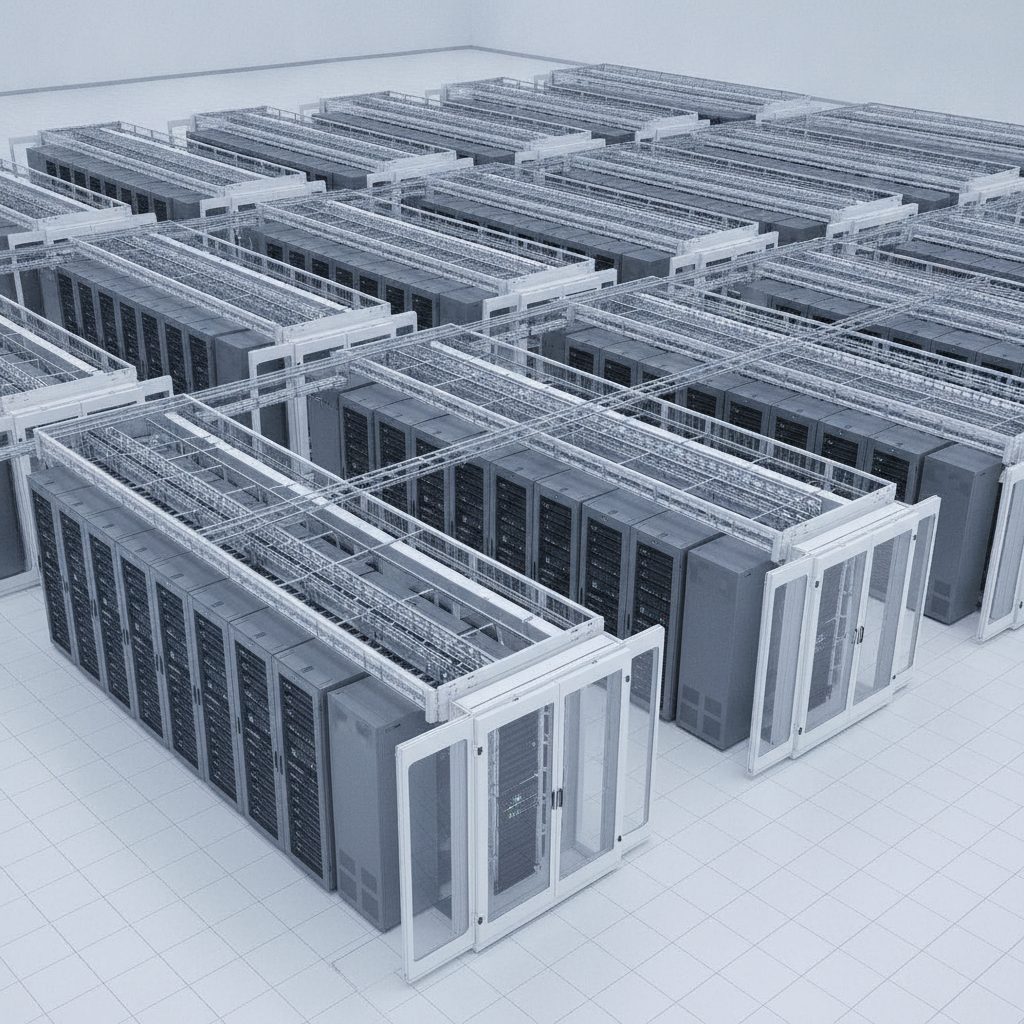
 Symbolbild · KI-generiert
Convertible Notes as Growth Capital: What Nscale's $3.4B Round Reveals

When Debt Is Allowed to Become Equity
A British company not yet listed on any stock exchange raises more than three billion U.S. dollars — not through a conventional capital increase (share issuance), not through a bank loan, but through an instrument known in the financial world as a convertible note. Nscale, a so-called AI neocloud company from the United Kingdom that is investing heavily in AI data centers, chose exactly this path, bringing on board investors including Nvidia and hedge fund Third Point. The deal illustrates a mechanism that is particularly common in the growth and tech segment — and that offers investors both opportunities and significant risks.
Convertible notes are not a new phenomenon. In earlier technology cycles — during the dot-com boom of the late 1990s, for example, or during the electric vehicle hype of the early 2020s — high-growth but still unprofitable companies used this instrument to raise capital without immediately relinquishing control over equity stakes. What makes the Nscale round particularly instructive is the combination of sheer volume, the timing shortly before a planned U.S. IPO, and the unusual investor structure.
The Instrument Explained: Debt with an Equity Option
A convertible note is, at its core, a loan: the company receives money and typically pays an interest rate — usually lower than on a conventional corporate loan, because the creditor receives an additional option. That option is the heart of the instrument: under certain conditions, the creditor can convert their claim into shares of the company instead of demanding repayment of the principal.
For the issuing company, this means in the short term: liquidity without immediate dilution. The new shares are only created upon conversion — which frequently occurs at or after an IPO, when a market price is available as a reference. For the investor, it acts as a kind of hedge: if the company performs poorly, they can theoretically call in the debt. If it performs well, they participate in the upside through the shares.
For comparison: when Tesla issued several convertible notes between 2012 and 2015, many early investors used exactly this instrument to gain exposure to the company without paying the full share price. Conversion happened gradually — and diluted the stake of original shareholders at each step.
Nvidia as a Financier of Its Own Customer — A Structural Issue?
Particularly noteworthy is Nvidia's participation in this funding round. Nvidia manufactures the graphics processing units (GPUs) that companies like Nscale require for their AI data centers. Nscale therefore buys Nvidia's hardware — while Nvidia simultaneously invests in Nscale. This entanglement is structurally significant.
On one hand, such a stake signals confidence: a strategic investor like Nvidia knows the market, understands the technology, and sends a visible signal with its capital. On the other hand, it creates a dependency that investors should examine closely in their analysis. What happens if Nscale wants to switch to a different GPU platform as technology evolves? How independent can strategic decisions be when a key supplier is simultaneously a shareholder?
This phenomenon — known as vertical integration in the financing context — appears in other sectors as well: a pharmaceutical company financing its clinical contract research partner, or a defense group investing in one of its suppliers. In each case, it is worth carefully analyzing the interests of the parties involved.
| Financing Type | Dilution | Repayment Obligation | Typical Use Case |
|---|---|---|---|
| Capital increase (share issuance) | Immediate | None | Listed growth companies |
| Convertible note | Deferred (upon conversion) | Yes, if not converted | Pre-IPO, growth stage |
| Bank loan | None | Yes, with interest | Profitable companies with collateral |
| Venture capital | Immediate (new shares) | None | Early stage, start-ups |
What This Deal Reveals About the AI Infrastructure Market
Nscale is not a small start-up. A round of this size — $3.36 billion — positions the company among the major AI infrastructure providers competing with established hyperscalers such as Amazon Web Services, Google Cloud, and Microsoft Azure. The term neocloud describes providers that rent out specialized GPU compute capacity for AI workloads without offering the broad product portfolio of the hyperscalers.
For the market as a whole, the transaction illustrates just how capital-intensive AI infrastructure really is. Data centers, cooling systems, networking technology, power supply — the investments add up quickly into the billions before a single byte of AI compute is rented out. This explains why companies in this segment are almost inevitably dependent on external financing before they become profitable. The cash runway — the period a company can sustain operations with its available funds before requiring new capital — is a critical metric here.
For small-cap investors, the lesson is transferable: smaller companies in the AI infrastructure space often follow similar patterns. A company with high capital requirements and negative operating cash flow will sooner or later return to the capital markets — either through new share issuances, new convertible notes, or debt financing. Each of these options has consequences for the value of existing shares.
Structural Features Investors Should Monitor
What can the Nscale transaction teach us for analyzing similar situations? Three structural features deserve particular attention:
First: Conversion terms and valuation anchors. Convertible notes typically include a conversion premium — the markup above the current or future share issuance price at which conversion becomes attractive. The higher this premium, the less dilutive the instrument is under normal conditions — but under stress (for example, a weak market environment at the time of the IPO), conversion terms can also be renegotiated, which may worsen dilution.
Second: Strategic vs. financial investors. The participation of a strategic investor like Nvidia signals validation on one hand, and a conflict of interest on the other. Pure financial investors have different objectives — typically a clean return at or after the IPO. The mix of different investor types in a single round can be both stabilizing and a source of conflict.
Third: IPO timing and market environment. Convertible notes issued shortly before a planned IPO are tightly linked to the IPO outcome. If the listing is delayed — due to volatile markets or regulatory hurdles, for instance — the period during which the company must bear the interest burden without being able to complete the conversion also extends.
Glossary: Key Terms in Convertible Note Financing
- Convertible Note
- A debt instrument that grants the creditor the right to convert their claim into shares of the issuer under certain conditions. Combines characteristics of debt and equity.
- Dilution
- When an existing shareholder's percentage stake decreases because new shares are issued — for example upon conversion of convertible notes — this is referred to as dilution. The absolute share price may also fall if the market reprices to reflect the increased share supply.
- Cash Runway
- The period a company can sustain operations with its available liquid funds at a constant monthly burn rate. Formula: cash balance ÷ monthly net cash outflows. A short runway increases pressure to raise capital — often on unfavorable terms.
- Neocloud
- A cloud provider that specializes in GPU compute capacity for AI workloads, without holding the broad product portfolio of the major hyperscalers (Amazon, Google, Microsoft). Neoclouds are capital-intensive and dependent on chip supply chains.
- Strategic Investor
- A company that invests in another market participant to achieve operational advantages — such as securing sales markets or access to technology. Unlike a financial investor, the primary goal is not return on investment alone.
- Conversion Premium
- The markup above the current share price at which conversion into shares takes place. A high premium means: the share price must rise significantly before conversion becomes attractive for the noteholder.
- Vertical Integration (financing context)
- When a company acts as both supplier and investor along the value chain — for example, a GPU manufacturer that simultaneously finances a GPU customer. This creates potential conflicts of interest that should be analyzed in due diligence.
⚠️ Important notice: This article is for informational and educational purposes only. It does not constitute investment advice, a recommendation, or a solicitation to buy or sell any security. Investments in small-cap exploration and mining companies carry a high risk, including the potential total loss of capital. Before making any investment decision, consult a registered financial advisor and conduct your own analysis. Aktienatlas-Redaktion is not responsible for decisions taken based on the content published here.
Educational content only, not investment advice. Small caps are highly speculative and total loss is possible.