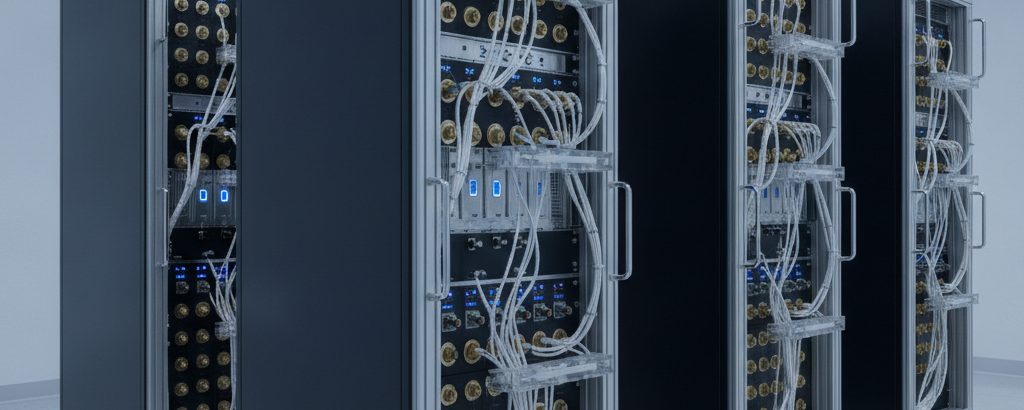
 Symbolbild · KI-generiert
Bookings vs. Cash: What Quarterly Results in the Quantum Sector Really Reveal
When order books shine but the bank account stays silent
It is earnings season in the quantum computing sector: several listed companies have presented their quarterly results in quick succession — and the picture that emerges is typical of a young technology industry at the transition from the research phase to early commercialisation. D-Wave Quantum (Nasdaq: QBTS) reported a 611 per cent year-on-year surge in bookings, yet missed profitability expectations by a considerable margin. Quantum Computing Inc. (Nasdaq: QUBT) beat analyst revenue estimates but continued to report a substantial operating loss — and its shares fell after the results. IonQ (NYSE: IONQ), by contrast, raised its revenue guidance, briefly lifting the entire sector; Rigetti Computing (Nasdaq: RGTI) and D-Wave also rose in its wake.
For seasoned sector observers these patterns are familiar. For beginners, however, they represent a classic trap of confusion: how can a company collecting orders at triple-digit percentage rates simultaneously post losses and drain its cash? The answer lies in carefully distinguishing three metrics that are all too easily conflated in the noise of quarterly reports: bookings, revenue, and cash runway.
Bookings Growth vs. Profitability Q3 (%)
Three metrics that rarely move in sync
In the early stage of a technology industry, order intake, revenue recognition, and liquidity frequently follow entirely different timelines. To understand why, it helps to look at the underlying mechanics:
Bookings (order intake) are legally binding orders or contractual commitments that a company has received — but not yet invoiced. They show how much demand exists in the market for a product or service. When bookings rise by 611 per cent, as at D-Wave, the signal is clear: more customers want the product. Yet this signal says nothing about when the money will actually arrive in the account.
Revenue is only recognised once the contractually agreed service has been delivered and invoiced to the customer. In complex technology projects — and quantum computing implementations are highly complex — this can happen months or even years after the original booking. The book-to-bill ratio relates the two: a value above 1.0 signals that more new orders are coming in than are being invoiced. That is broadly a positive sign for future growth — but not proof of current financial strength.
Cash runway, finally, describes how many months a company can survive on its current cash balance at an unchanged monthly burn rate before new capital is required. Formula: cash balance ÷ monthly burn rate = months remaining. For quantum computing companies financing high research costs, expensive specialists, and complex infrastructure, this figure can be alarmingly small — even when the order books are full.

Why the market reacts anyway — and why that is risky
The fact that IonQ gained around 8 per cent after raising its revenue guidance and pulled competitors' share prices higher with it is no coincidence. Capital markets are forward-looking: they price not today's cash flow but expected future earnings. In a sector like quantum computing — where commercial maturity could still be years away — bookings and guidance revisions are the rare data points by which the market navigates. Every positive signal is therefore absorbed disproportionately.
This mechanism is well known from the history of technology. In the early dot-com era, companies were valued by page views long before business models existed. During the cloud boom of the 2010s, ARR growth rates were treated as the primary valuation basis while losses were ignored. Similar phases occurred in the fuel cell sector around 2000 and in the cannabis market around 2018. The pattern is always the same: the market prices in a technology narrative before the numbers confirm it.
This is not a failure of markets — it is their function. Risk capital flows into early-stage sectors because high risks come with potentially high returns. But the danger for beginners is real: anyone who reads a quarterly result superficially and interprets "611 per cent bookings growth" as a buy signal without checking the cash runway is taking on a risk they may not fully grasp.
| Company | Ticker / Exchange | Quarterly Signal | Limitation |
|---|---|---|---|
| D-Wave Quantum | QBTS / Nasdaq | Bookings +611 %, revenue +21 % | Missed earnings expectations, operating loss |
| Quantum Computing Inc. | QUBT / Nasdaq | Revenue above analyst estimate | Substantial operating loss, shares fell after results |
| IonQ | IONQ / NYSE | Revenue guidance raised | No net profit yet, structurally high burn rate |
| Rigetti Computing | RGTI / Nasdaq | Benefited from sector sentiment | Standalone figures to be assessed separately |
Dilution risk: the silent companion
One aspect that easily gets lost in the excitement over bookings records: when the cash runway runs low, quantum computing companies must raise fresh capital. This almost always happens through a capital increase (share issuance) — the issue of new shares. The effect is called dilution: existing shareholders see their percentage stake in the company shrink because more shares are in circulation. If the new capital is raised at a price below the current market price — which is common in difficult market conditions — the existing share loses additional value.
In the quantum computing sector this mechanism is structural: most companies are still far from profitability. High R&D expenditure, specialised hardware (cryostats, ion traps, control electronics), and the competition for qualified personnel generate burn rates that can only be covered by external capital. For investors this means: even a glittering quarterly result on the bookings side does not automatically protect against dilution — if the next capital requirement is drawing closer.
A comparison from the biotech industry makes this vivid: a pharmaceutical company can present excellent Phase II data and yet shortly afterwards announce a capital increase because Phase III must be financed. The positive data point and the negative dilution effect are not mutually exclusive — they simply follow different timelines. The same principle applies in quantum computing.
What this earnings season teaches us about reading quarterly data
The current earnings season in the quantum computing sector provides a compact case study in how beginners can read quarterly figures more systematically. Three steps help:
First: separate bookings from revenue. A high order intake is an indicator of future revenue — but not a substitute for it. Check how large the backlog is and over what timeframe it is expected to be invoiced.
Second: calculate the cash runway. Cash balance and burn rate are disclosed in quarterly reports (10-Q for US-listed companies). Dividing the two gives the months remaining until the next capital requirement. If that figure is below twelve months, the probability of a capital increase rises considerably.
Third: read guidance revisions in context. When IonQ raises its revenue guidance, that is a positive signal — but an investor should check whether the increase is based on already invoiceable contracts or on expectations for projects not yet booked. The difference is significant for the reliability of the forecast.
None of this protects against the fundamental risks of an early-stage sector. Quantum computing remains at an early stage both technologically and commercially. The timeline to broad economic viability — that is, the point at which companies sustainably earn more than they spend — is uncertain and depends on external factors: advances in error correction, standardisation of interfaces, regulatory frameworks, and budget decisions by major customers such as governments and large corporations.
Key terms for the quantum computing investor
- Bookings (order intake)
- Legally binding orders or contractual commitments that have not yet been invoiced. Bookings reflect demand dynamics, not current cash flow.
- Book-to-bill ratio
- Order intake divided by invoiced revenue in the same period. A value above 1.0 signals order growth, but says nothing about profitability.
- Revenue
- Income generated through delivered and invoiced services. Unlike bookings, revenue has an immediate effect on liquidity.
- Cash runway
- Cash balance divided by monthly burn rate — the result shows how many months the company can operate without new capital.
- Burn rate
- Monthly net cash outflow of a company that is not yet profitable. High burn rates in quantum computing are structural, driven by R&D and hardware costs.
- Capital increase / dilution
- The issue of new shares to raise capital. This leads to dilution of existing stakes — particularly detrimental when new shares are issued below the current market price.
- Guidance revision
- An update to management's revenue or earnings forecast. Raised guidance is regarded as a positive signal, but its underlying data basis should always be examined.
⚠️ Important notice: This article is for informational and educational purposes only. It does not constitute investment advice, a recommendation, or a solicitation to buy or sell any security. Investments in small-cap exploration and mining companies carry a high risk, including the potential total loss of capital. Before making any investment decision, consult a registered financial advisor and conduct your own analysis. Aktienatlas-Redaktion is not responsible for decisions taken based on the content published here.
Educational content only, not investment advice. Small caps are highly speculative and total loss is possible.