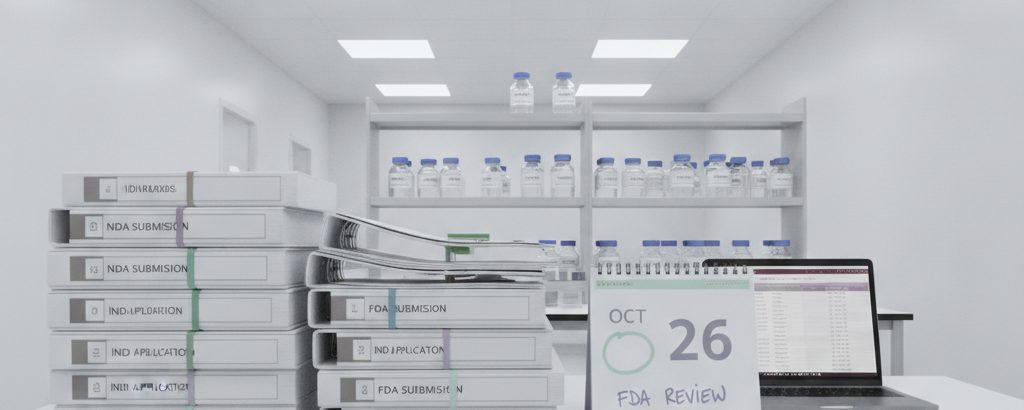
 Symbolbild · KI-generiert
Bankruptcy Before FDA Decision: When the Cash Runway Runs Out
Eleven Weeks Short: A Case Study in Capital and Approval
In the world of biotech small caps, a common unspoken assumption persists: any company with promising clinical data will somehow find a way to raise capital. A recent industry case shatters that logic in dramatic fashion. A publicly listed biotech company filed for bankruptcy at a point when the FDA's decision on the approval of its core product was just eleven weeks away. The company had survived the clinical phase, the regulatory finish line was almost in sight — and yet it ran out of capital before the end.
For investors who are active in biotech small caps or considering entering the space, this is not an outlier — it is a structural warning: clinical quality and financial viability are two entirely separate dimensions, and both must be in order at the same time.
Financing Structures in Biotech Compared (Risk Score (1–3))
Why the Timing of Financing Changes Everything
The business model of small biotech companies differs fundamentally from that of traditional industrial or technology firms. As a rule, they generate no operating cash flow for years on end. Instead, they burn capital on research, clinical trials, regulatory processes, and personnel — with the goal of eventually securing an approval that enables revenue. This business model makes them structurally dependent on external capital.
The cash runway — that is, the number of months a company can sustain operations using its current cash balance at its ongoing monthly burn rate — is the single most important survival metric. The formula is straightforward: cash on hand divided by monthly expenditures equals time remaining. However, the true significance of this metric depends critically on context: How far away is the next regulatory milestone? And how many months of buffer remain after that for execution?
If the FDA decision is three months away and the cash runway is four months, the situation is theoretically manageable — but there is almost no margin for delays, unforeseen costs, or a sluggish capital market. If the runway is only two months, the situation becomes existentially threatening, even if the clinical data are excellent.

Three Financing Structures and Their Different Risks
Not every biotech company finances itself in the same way. The choice of financing structure significantly influences how vulnerable a company is during the critical phase just before an approval decision.
Equity financing through capital increases (share issuances) is the most common form. It dilutes existing shareholders but strengthens the equity base and creates no repayment obligation. The problem: in weak market conditions or when share prices are falling, a new funding round can fail entirely or come together only under heavily dilutive terms.
Convertible notes provide the company with short-term liquidity but are legally debt instruments. If they are not converted into equity or repaid in time, creditors can assert claims — and this is precisely what can trigger bankruptcy, even when the clinical outlook is favorable.
Non-dilutive grants — that is, non-dilutive public funding from government programs such as the NIH in the United States or innovation funds in Europe — are considered the most attractive form of financing. They strengthen the balance sheet without diluting shareholders or creating repayment obligations. However, they are time-limited, highly competitive, and rarely cover the entire financing requirement.
A biotech company that relies exclusively on a single one of these sources is more vulnerable than one with a diversified financing structure. When reviewing a company's annual report, investors should examine not only the cash balance but also the maturity schedule of liabilities — because a maturing convertible note can effectively shorten the runway before the bank account is empty.
| Financing Structure | Dilution Risk | Repayment Obligation | Typical Source |
|---|---|---|---|
| Capital Increase (Equity) | High | No | Institutional investors, retail investors |
| Convertible Note | Medium (upon conversion) | Yes (until conversion) | Hedge funds, specialist investors |
| Non-dilutive Grant | None | No | NIH, government funding programs |
What This Case Reveals About the Mechanics of Biotech Valuations
Why does a company run out of steam so close to the finish line in the first place? The answer lies in a structural mismatch: the costs of clinical trials and regulatory processes are difficult to estimate and are frequently underestimated. Phase III trials run longer than planned, FDA information requests generate additional workload, and the capital markets for small caps can temporarily dry up completely — particularly during periods of rising interest rates, when institutional investors reduce their exposure to high-risk positions.
A psychological dynamic compounds the problem: the closer the potential approval date gets, the harder a new funding round becomes to execute. On one hand, existing shareholders resist dilution just before the "big moment." On the other hand, new investors shy away from the timing risk: what happens if the FDA rejects the application and the share price collapses shortly after they have just invested?
This dilemma explains why experienced biotech investors apply the rule of thumb that a biotech company should ideally maintain a cash runway of at least 18 to 24 months — regardless of how close a catalyst event may appear. This is not an arbitrary number but a buffer for delays, renegotiations, and the period after approval before initial revenues from the market launch begin to flow.
An analogous example from corporate history: in the early 2000s, several semiconductor startups failed not because of inadequate technology, but because their manufacturing capacity could not be scaled up in time — due to a lack of capital for capital expenditure. The principle is the same: the best technology is worthless if the money runs out first.
What Investors Can Take Away From This Pattern
The case described here is not a one-off — it is representative of a recurring pattern in the biotech segment. Anyone who invests in this space, or is planning to, should work through several key questions before entering a position.
First: what is the current cash balance as reported in the most recently published quarterly filing? Second: what is the monthly burn rate, and does the resulting runway extend sufficiently beyond the next regulatory event — including a buffer period afterward? Third: what financing structures has the company used to date, and are there any outstanding liabilities with near-term maturities?
Fourth — and this is often underestimated — investors should check whether the company has access to flexible capital sources: does it have an at-the-market facility (ATM) that allows small capital raises without a formal announcement? Are there committed credit lines in place? These instruments can buy valuable weeks in a cash-constrained situation.
Biotech investments are conceived with a long-term horizon in mind, and there are companies that successfully raise capital despite a tight runway and go on to receive their approval. But the structural risks are real — and the cash runway is not an abstract figure buried in a footnote of the annual report; it is the single most concrete survival metric a pre-commercial clinical-stage company possesses.
Key Terms for Biotech Investors
- Cash Runway
- The remaining time a company can sustain operations using its current cash balance at its ongoing burn rate. Calculation: cash on hand ÷ monthly net expenditures = months until capital is exhausted.
- Burn Rate
- The monthly rate at which a company consumes capital in the absence of its own revenues. Comprised of personnel costs, trial costs, administration, and regulatory expenditures.
- Non-dilutive Financing
- Financing structures that do not dilute existing shareholders — for example, government grants, upfront licensing payments, or collaboration payments from pharmaceutical companies.
- Convertible Note
- An instrument that begins as debt and can be converted into equity (shares) under certain conditions. Until conversion, a repayment obligation exists, which can trigger bankruptcy.
- Dilution
- The reduction of existing shareholders' percentage ownership through the issuance of new shares. Common causes include capital increases, the conversion of convertible notes, and the exercise of stock options.
- PDUFA Date
- The deadline set by the FDA by which an approval decision on a new drug must be made. Regarded as a key catalyst event for biotech stocks.
- At-the-Market Facility (ATM)
- A market-based instrument that allows companies to continuously sell small blocks of shares at the prevailing market price without announcing a formal capital increase. Enables flexible, incremental liquidity raising.
- Total Loss of Capital
- The complete loss of invested capital. In the event of a biotech company's bankruptcy, equity holders (shareholders) rank last in the creditor hierarchy — and in practice frequently receive nothing.
⚠️ Important notice: This article is for informational and educational purposes only. It does not constitute investment advice, a recommendation, or a solicitation to buy or sell any security. Investments in small-cap exploration and mining companies carry a high risk, including the potential total loss of capital. Before making any investment decision, consult a registered financial advisor and conduct your own analysis. Aktienatlas-Redaktion is not responsible for decisions taken based on the content published here.
Educational content only, not investment advice. Small caps are highly speculative and total loss is possible.