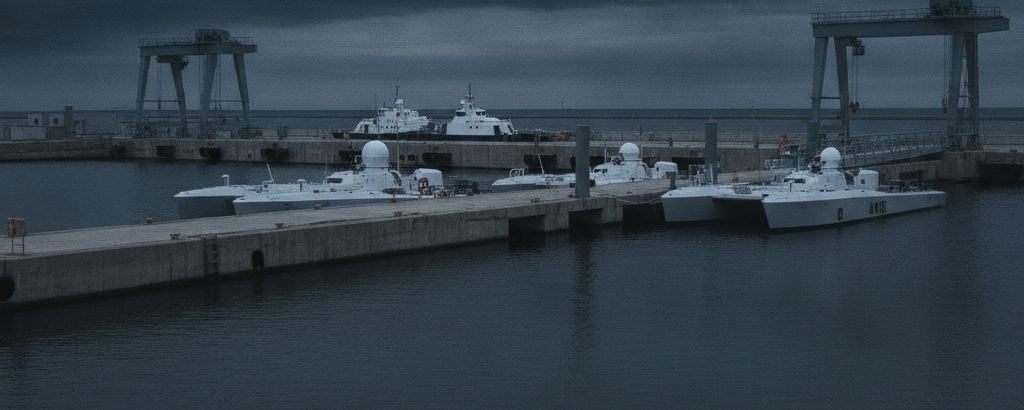
 Symbolbild · KI-generiert
Autonomous Naval Vessels: What MUSV Procurement Really Means
The Maritime Robot as a Procurement Case: Why Phase II Matters
Unmanned surface vessels are no longer a vision of the future — they are an active procurement target for the U.S. Navy. By entering Phase II of the Medium Unmanned Surface Vessel (MUSV) program, the U.S. Department of Defense has taken a clear development step: it is seeking autonomous ships capable of operating at sea for ten days without resupply and carrying two standard containers. For investors looking to gain exposure to the defense segment, this step is far more than a press release — it marks a structural inflection point in the procurement cycle.
Defense programs run in clearly defined phases. In Phase I, concept studies and initial prototypes are developed, often with broad participation from a wide range of suppliers. Phase II means the concept has been validated, requirements have been specified in detail, and competition becomes technically more demanding. This reduces concept risk for suppliers on one hand, while significantly raising the bar for smaller companies on the other.
Risk Profile by Procurement Phase (Level (1–4))
Autonomy, Sensors, Energy: The Supply Chain Behind the Unmanned Vessel
What goes into a robot ship? At first glance, an autonomous surface vessel may seem technically straightforward — no cockpit, no crew quarters, no life-support systems. In reality, the technological depth is substantial: autonomous navigation requires high-precision sensors (lidar, radar, optical systems), robust communications architecture, and redundant decision logic capable of operating at sea for days at a time without human intervention.
For small-cap investors, this complexity is the actual starting point. Defense programs like the MUSV typically create multi-layered supply chains: the prime contractor takes responsibility for integration and the overall system, while specialized suppliers contribute subsystems — propulsion technology, energy management systems, sensor platforms, and software modules for mission control. It is precisely in these niche areas that listed small caps can be found, companies that may benefit from framework programs without bearing the total risk of the prime contract themselves.
A comparison illustrates the dynamic: when the U.S. Air Force moved its Reaper UAV program into the series production phase, not only the prime contractor General Atomics benefited, but dozens of specialized suppliers — from avionics manufacturers to satellite communications providers. Similar patterns can be observed in the procurement of surface drones, which became visible in combat use for the first time during the conflict in Ukraine.

Book-to-Bill and Burn Rate: The Two Key Metrics for Suppliers
Defense small caps participating in procurement programs like the MUSV operate in a distinctive economic environment. On the revenue side, they need sufficient order volume to cover their development costs. On the cost side, certification requirements, military quality standards (including MIL-SPEC), and lengthy acceptance testing drive expenses higher — often before a single call-off from a framework agreement has been made.
Two metrics are particularly informative in this context:
- Book-to-Bill Ratio: The ratio of order intake to recognized revenue. A value above 1.0 signals that more orders are coming in than are being billed — indicating growth potential. A ratio persistently below 1.0 points to a shrinking order pipeline.
- Cash Runway: How long will the company's current cash balance last at the prevailing monthly burn rate? For small caps without ongoing profits, this figure is existential. A company with strong technology but only three months of cash reserves is under enormous pressure — and may be forced to carry out a dilutive capital increase (share issuance).
Particularly during the transition from Phase I to Phase II, expenditures rise before revenues flow in. This is not an exception — it is the rule in defense procurement. Understanding this mechanism helps investors put reports of "framework agreements won" into proper perspective: they are a step in the right direction, but not yet a guarantee of positive cash flows.
| Procurement Phase | Risk Profile | Revenue Probability |
|---|---|---|
| Phase I (Concept) | Very High | Low |
| Phase II (Development) | Medium-High | Limited, project-specific |
| Phase III (Production Readiness) | Medium | Substantial upon order call-off |
| Series Production | Low-Medium | Predictable under framework agreement |
What the MUSV Cycle Reveals About the Broader Defense Segment
The MUSV program does not exist in isolation. It reflects a broader trend across Western defense ministries: the systematic shift toward unmanned, autonomous systems — at sea, on land, and in the air. NATO members have increased their defense spending, and a growing share of these funds is flowing into technology segments where specialized small caps can compete: autonomy software, swarm communications, maritime energy storage, and sensor-based obstacle detection.
For small-cap investors, this creates a dual reading: on one hand, the addressable market is growing, which generates opportunity. On the other hand, the entry of larger defense primes into these niches increases competitive pressure. An autonomy specialist with ten employees may be a technology leader — but when major defense contractors build out their own dedicated divisions, the competitive dynamics shift fundamentally.
There is also certification risk to consider: military systems must pass rigorous acceptance procedures. A technically functional system can be stuck in approval loops for months — time that consumes capital. If certification fails, investors in companies with no alternative revenue streams may face a total loss of capital in the worst case.
A historical example illustrates this: several small caps that bet on military contracts during the early UAV boom of the 2000s were forced to file for insolvency despite having technologically recognized products — because certification cycles lasted longer than their cash runway allowed.
Understanding Procurement Logic Before You Invest
The U.S. Navy's MUSV program teaches a general lesson about defense small caps: entering a new procurement phase is a signal — but not a buy signal. It is an indicator that a program is maturing and that the addressable volume is becoming more tangible. Whether individual companies benefit depends on their technological specialization, their cash runway, their order structure (firm call-off vs. framework agreement), and their ability to survive military certification processes.
Investors monitoring the defense segment should learn to distinguish between the program level (what is the military procuring?) and the company level (who is actually delivering, at what price, and with what margin?). Only those who understand both levels can assess whether news about a framework agreement is substantive — or merely an entry ticket to a long, costly development race.
Key Terms for Defense Investors
- MUSV (Medium Unmanned Surface Vessel)
- A class of medium-sized unmanned surface vessels being developed by the U.S. Navy for autonomous reconnaissance, logistics, and combat support. Phase II refers to the development and qualification phase following concept validation.
- Framework Agreement
- A contract that defines maximum procurement quantities and technical requirements but does not contain a binding order. Specific delivery call-offs are made separately and are not guaranteed.
- Book-to-Bill Ratio
- The ratio of order intake to billed revenue over a given period. A value above 1.0 signals a growing order pipeline; a value below 1.0 indicates declining demand.
- Cash Runway
- The period during which a company can continue operating with its current cash balance at a given monthly burn rate before additional capital is required. For unprofitable small caps, this is an existential metric.
- Burn Rate
- A company's monthly net cash outflows when it generates no revenue or insufficient revenue. Combined with the cash balance, it determines the cash runway.
- MIL-SPEC (Military Specification)
- U.S. standardization requirements for military equipment. Products must meet these standards before they can be included in procurement programs — a time-intensive and costly process for small suppliers.
- Prime Contractor
- The lead contractor of a defense program, responsible for system integration and engaging specialized suppliers (subcontractors). Small caps typically operate as subcontractors.
- Total Loss of Capital
- The complete loss of invested capital — a realistic scenario in speculative small caps, for example in the event of insolvency, failed certification, or severe dilution through capital increases (share issuances).
⚠️ Important notice: This article is for informational and educational purposes only. It does not constitute investment advice, a recommendation, or a solicitation to buy or sell any security. Investments in small-cap exploration and mining companies carry a high risk, including the potential total loss of capital. Before making any investment decision, consult a registered financial advisor and conduct your own analysis. Aktienatlas-Redaktion is not responsible for decisions taken based on the content published here.
Educational content only, not investment advice. Small caps are highly speculative and total loss is possible.